Author: Wycliffe Nyamasege

  • Ramaphosa speaks on relations with Kagame amid DRC mediation efforts

    Speaking during a panel at the Africa CEO Forum in Abidjan, Ramaphosa responded to perceptions of a strained relationship, saying, “People may think that President Kagame and I are in conflict. Some of you may have expected fireworks as we sit close to each other.”

    The South African Head of State’s remarks were part of a broader reflection on regional peace efforts in the DRC and the role of African-led initiatives.

    Ramaphosa praised the continental mediation frameworks, including the Nairobi and Luanda processes, as essential to building confidence and laying the groundwork for ceasefires and troop withdrawals, including the recent pullout of SADC forces from eastern DRC.

    “All these efforts have been building a very strong and firm foundation,” he said, adding that while international involvement is welcome, “we must also remember the principle that we have adopted as Africa: African solutions for African problems.”

    President Kagame, who also took part in the session, acknowledged the multiplicity of peace efforts, including those led by Qatar and the United States, but cautioned that none had yet succeeded fully.

    He called for greater coherence in African efforts and less dependence on external actors. “Much progress has been made. But there are things we still haven’t done,” Kagame said.

    The remarks came months after the two leaders sharply differed on conflicting statements over the conflict in the eastern DRC.

    Back in January, President Kagame accused South African officials, including President Ramaphosa, of distorting private conversations and misrepresenting Rwanda’s position on the conflict in eastern Congo, particularly regarding alleged warnings to Rwanda and the involvement of Rwanda Defence Forces (RDF) soldiers in the war between M23 rebels and Congolese forces.

    “What has been said… contains a lot of distortion, deliberate attacks, and even lies,” Kagame posted on his X account in response to a message shared by Ramaphosa.

    South Africa had deployed troops to the DRC under the Southern African Development Community Mission in the DRC (SAMIDRC), supporting Kinshasa’s military alongside various militias, including the FDLR—a group formed by the perpetrators of the 1994 Genocide against the Tutsi in Rwanda.

    Kagame took issue with remarks made by South African Defence Minister Angie Motshekga, who claimed that Ramaphosa had warned Rwandan forces that continued hostilities against South African troops would be viewed as a declaration of war, following the deaths of 14 soldiers in clashes near Goma.

    SAMIDRC’s mission was terminated in March to allow for the resolution of the conflict through diplomatic means, and Rwanda has since granted safe passage to troops withdrawing from eastern DRC.

    President Paul Kagame and his South African counterpart, Cyril Ramaphosa, during the latter’s visit to Kigali in April 2024. On Monday, May 12, 2025, Ramaphosa addressed perceptions of tensions with Kagame amid ongoing efforts to mediate the protracted conflict in eastern Democratic Republic of Congo (DRC).
    President Kagame, who also took part in the session, acknowledged the multiplicity of peace efforts, including those led by Qatar and the United States, but cautioned that none had yet succeeded fully.gqvsb9bwcaa4imi.jpgThe annual Africa CEO Forum brings together 2,000 leaders from over 70 countries.

  • PM Ngirente urges regional collaboration to unlock aviation’s economic potential

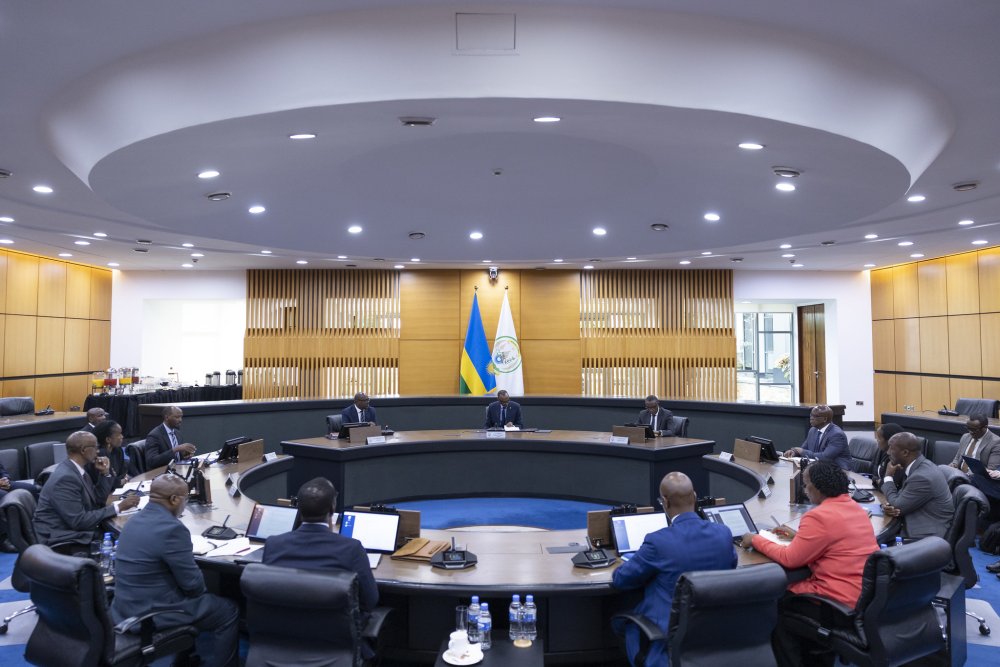
    Dr. Ngirente made the remarks during the official opening of the 13th Aviation Stakeholders Convention at the Kigali Convention Centre on Monday, May 12, 2025.

    Addressing aviation leaders and policymakers from across the continent, Ngirente underscored the importance of collective efforts in shaping the future of African air travel. He said initiatives such as the Single African Air Transport Market (SAATM) and the African Continental Free Trade Area (AfCFTA) are vital frameworks that require improved air connectivity to deliver on their promise.

    “Rwanda’s ambitions do not exist in isolation, and we all know that Africa’s growth is interconnected,” Ngirente stated. “An integrated African airspace will lower costs, improve competition, and unlock economic opportunities across the continent.”

    The Prime Minister praised RwandAir’s role in connecting Africa to the world, describing it as one of the fastest-growing airlines on the continent, now reaching over 100 destinations through direct and codeshare routes. He noted the airline’s growing popularity among young people, with nearly 2,000 applicants for its cadet pilot programme this year alone.

    Ngirente reaffirmed Rwanda’s commitment to investing in aviation infrastructure, including the expansion of Kigali International Airport and construction of the new Bugesera International Airport. These, he said, are more than transport projects—they are “economic multipliers” supporting trade, tourism, and employment.

    The new Bugesera International Airport, being constructed in partnership with Qatar Airways, is expected to be completed by 2028 at a cost of $2 billion.

    Calling on governments and industry players alike, the Prime Minister urged the creation of stable, transparent environments to foster innovation, cross-border cooperation, and sustainable growth within the aviation sector.

    “We must turn today’s commitments into real progress for the millions of Africans who will benefit from a connected, competitive, and sustainable aviation sector,” he said.

    The convention, organised by the African Airlines Association (AFRAA) in partnership with RwandAir, brings together stakeholders to explore strategies for innovation and sustainability under the theme “Sustainability. Collaborate. Innovate.”

    Dr. Ngirente appealed for regional collaboration during the official opening of the 13th Aviation Stakeholders Convention at the Kigali Convention Centre on Monday, May 12, 2025.The convention, organised by the African Airlines Association (AFRAA) in partnership with RwandAir, brings together stakeholders to explore strategies for innovation and sustainability under the theme “Sustainability. Collaborate. Innovate.”gqvmcfhxsae0hb7.jpg

  • President Kagame in Abidjan for Africa CEO Forum

    The annual summit brings together over 2,000 participants from more than 70 countries for two days of high-level discussions, debates, and networking sessions aimed at accelerating the private sector’s role in Africa’s development.

    On Monday morning, President Kagame is expected to join a distinguished panel of African leaders, including President Alassane Ouattara of Côte d’Ivoire, President Bassirou Diomaye Faye of Senegal, President Mohamed Ould Ghazouani of Mauritania, and President Cyril Ramaphosa of South Africa, for the forum’s official opening ceremony.

    Later, President Kagame will contribute to a presidential panel discussion on “Policies, Practices and Personalities Fit for the New World Order.”

    The session will focus on how African leadership can adapt to a shifting global landscape, where transactional geopolitics are becoming the norm, limiting traditional avenues of international cooperation for many African nations.

    Held under the theme “Africa in a Transactional World: Can a New Deal Between State and Private Sector Deliver the Continent a Winning Hand?”, this year’s forum emphasises the need for stronger collaboration between African governments and the private sector to unlock inclusive economic growth and resilience.

    Other prominent speakers at the 2025 edition include President John Dramani Mahama of Ghana, Prime Minister Kassim Majaliwa of Tanzania, Prime Minister Amadou Oury Bah of Guinea, and Côte d’Ivoire’s own Prime Minister Robert Beugré Mambé, among others.

    The Africa CEO Forum, founded in 2012, has become a vital platform for shaping Africa’s economic agenda, fostering dialogue between public and private sector actors, and promoting cross-border investment opportunities.

    The 2024 edition of the Africa CEO Forum took place in Kigali, Rwanda, from May 16 to 17. Building on the success of that summit, Rwanda has once again been selected to host the 2026 edition of the summit.
    President Paul Kagame is in Abidjan, Côte d’Ivoire, to participate in the 2025 edition of the Africa CEO Forum, the continent’s premier gathering of business leaders, investors, and policymakers.

  • India reopens 32 airports for civilian flight operations after ceasefire with Pakistan

    The step was taken following a ceasefire agreement between the two countries reached on Saturday.

    In a statement on Monday, the state-owned Airports Authority of India said the 32 airports that were closed for civilian aircraft operations till 0529 hours local time of May 15 are now available for operations with immediate effect.

    The closure of these airports across northern and western parts of the country was announced after a military conflict that began last week between the two neighbours.

  • South Africa to open inquiry into DRC deployment, deaths of SANDF soldiers

    The revelation was made by Deputy Defence Minister Bantu Holomisa, who appeared before Parliament’s Joint Standing Committee on Defence on Friday, standing in for Defence Minister Angie Motshekga, who is currently in Russia.

    The primary objective of the commission of inquiry is to investigate the circumstances that led to the deaths of 14 South African soldiers in Goma and to understand why others were held as prisoners of war for at least three months.

    Appearing alongside senior officials from the South African National Defence Force (SANDF), Holomisa told Parliament that it was premature to assess whether the mission had been a success.

    “It’s too early to declare this operation a success or failure because we were not acting alone. The SADC Secretariat must also provide input on the outcomes of this mission,” Holomisa said.

    However, the committee expressed frustration over the limited information provided. Critics noted that, in the Minister’s absence, senior SANDF leadership shared only scant details, leaving lawmakers with more questions than answers.

    Joint committee co-chairperson Malusi Gigaba said it was too soon for Parliament to decide whether it would initiate its own investigation into the deployment.

    At least 18 SAMIDRC soldiers were killed early this year during clashes with the M23 rebel group in the battle to capture the cities of Goma and Sake. Among the dead were two Tanzanian and two Malawian soldiers, with dozens more sustaining injuries.

    The SAMIDRC’s offensive mission to dislodge M23 rebels began in December 2023. Critics had long warned that the troops were under-equipped and ill-prepared for the complexities of the conflict.

    South Africa is reported to have spent over R1.6 billion (approximately $88 million) on the operation.

    Mounting pressure from lawmakers and civil society ultimately led to the termination of the SAMIDRC mission in March, allowing for a shift toward diplomatic efforts to resolve the conflict between the rebels and the administration of President Félix Tshisekedi.

    Critics argue that the deployment exposed South African soldiers to unnecessary risk and suggest the mission may have been influenced by private interests rather than national security.

    The withdrawal of South African troops began in recent weeks, with soldiers and equipment exiting the DRC via Rwanda.

    Meanwhile, Zimbabwean activist Rutendo Matinyarare has called on the commission of inquiry to broaden its scope by examining the deeper causes of the conflict. He urged investigators to consider the findings in his recent documentary, which explores the historical factors fueling instability in the region, including the persecution of Kinyarwanda-speaking communities who have taken up arms to fight for their rights.

  • Staff of Kigali Marriott Hotel and Four Points by Sheraton visit Ntarama Genocide Memorial

    The commemoration event took place on May 9, 2025, at the Ntarama Genocide Memorial located in Bugesera District.

    The visit began with a historical briefing about Bugesera, especially the events leading up to the Genocide, highlighting how the area had been designated as a settlement for Tutsi with the intent of extermination.

    Participants were taken through some of the tragic history, including how Bugesera was once considered a cursed, uninhabitable place, suitable only for relocating Tutsi with the hope that they would perish due to the Tsetse fly.

    Mukabucyeri Angélique, a survivor of the 1994 Genocide against the Tutsi, shared her harrowing testimony. She recounted how survival was incredibly difficult as they were hunted by neighbours who knew them personally, making hiding nearly impossible.

    “I had a baby strapped to my back when they struck me on the head with a club. I lost consciousness and fell. They slashed the child on my back. When I woke up, I was carrying a dead baby and had nine stab wounds and scars all over my body,” she recounted.

    Aditya Chacko, General Manager of Kigali Marriott Hotel and Four Points by Sheraton Kigali, stated that they joined Rwandans in commemorating the 31st anniversary of the Genocide to honour the innocent victims who were brutally murdered in 1994.

    “We gather to honor the memory of the victims, recognize the incredible courage and resilience of the survivors, and acknowledge their tireless efforts to rebuild this nation,” he noted.

    “As representatives of Kigali Marriott Hotel and Four Points by Sheraton, we stand united with all Rwandans in supporting genocide survivors. It is crucial that we reflect on our roles to ensure that such atrocities and their ideologies are never repeated in Rwanda or anywhere else,” added Chacko.

    He also expressed gratitude to the Rwandan leadership, particularly to President Paul Kagame, for making the decisive choice to halt the genocide and for laying the groundwork for national unity.

    The managers and staff of Kigali Marriott Hotel and Four Points by Sheraton visited the Ntarama Genocide Memorial on May 9, 2025.Flowers were laid on the mass grave at Ntarama Genocide Memorial, where victims of the 1994 Genocide against the Tutsi are buried.kigalli_marriot_staff.jpgThe General Manager of Four Points and the Director of Human Resource also attended the eventkgmh4-92ce1.jpgThe managers and staff of Kigali Marriott Hotel and Four Points by Sheraton were briefed on the history of the 1994 Genocide against the Tutsi and shown how it was a long-planned and organised atrocity.kgmh1-abfd4.jpgStaff of Kigali Marriott Hotel and Four Points by Sheraton were given an overview of the dark history that characterised Bugesera.Mukabucyeri Angelique, a survivor of the 1994 Genocide against the Tutsi, shared how her survival was a difficult ordeal.Aditya Chacko, General Manager of Kigali Marriott Hotel and Four Points by Sheraton Kigali, stated that they joined Rwandans in commemorating the 31st anniversary of the Genocide to honour the innocent victims who were brutally murdered in 1994.

  • Surge in food prices drives Rwanda’s April inflation to 6.3%

    The monthly publication, which tracks changes in the cost of goods and services across the country, revealed that urban CPI rose by 6.3% and rural inflation surged to 6.9%. The urban inflation serves as the headline index for monetary policy decisions.

    Food and non-alcoholic beverages were the largest contributors to inflation, with urban prices in this category rising by 7.9% year-on-year and 2.7% month-on-month. This category carries a significant weight of 27% in the CPI.  

    Among the steepest increases was the price of meat, which surged 33.8% in urban areas and 35.5% in rural areas compared to April last year. Vegetables, a key staple in Rwandan households, also saw significant hikes—8.5% annually in urban areas and 6.6% in rural regions.  

    The fresh products index, which includes seasonal items such as fruits and vegetables, recorded a striking 14.6% annual rise. In contrast, energy prices saw a slight 0.7% decline on an annual basis, helping to moderate overall cost pressures.  

    A rise in restaurant and hotel charges also contributed to the surge in inflation, with prices increasing by 14.7%, according to NISR. While substantial, restaurants and hotels have a smaller weight of 9% in the CPI calculation compared to food.

    Prices of housing, water, electricity, gas, and other fuels (with a weight of 21%) went up by 3.3%, while transport prices (with a weight of 12%) grew by 3.8%.  

    On a monthly basis, Rwanda’s CPI increased by 2.3%, a noticeable jump from March, signalling continuing upward pressure on consumer prices.

    Meanwhile, core inflation, which excludes volatile items like fresh food and energy, rose by 4.4% year-on-year, suggesting broader underlying price increases.  

    The data is crucial in helping policymakers monitor inflation as part of broader economic stabilisation efforts.  

    Among the steepest increases was the price of meat, which surged 33.8% in urban areas and 35.5% in rural areas compared to April last year.

  • Tutsi bones in flower vases on the altar

    In the parishes of Kiziguro, Karubamba, Mukarange, Nyarubuye, and Kibungo—which were the only ones I had visited—death had become a permanent resident. Corpses lay strewn across altars, rotting in pews, piled in silence beneath the Stations of the Cross.

    The air was so thick with decay that even breathing felt like betrayal—an act of life in places meant to preserve it. The stench clung to the nostrils and the soul. No incense burned anymore, only the putrid odour of genocide.

    The air in eastern Rwanda no longer smelled like soil or rain. It reeked of death.

    I was there. I smelled it. I stepped over blood-soaked Bibles. I sat on pews where killers prayed before slaughtering families.

    And I conversed with others as though life were continuing, while in truth, we were living in a nightmare where the cross had become a machete, and the altar a butcher’s table.

    To this day, I sometimes question my sanity for having survived it— for having watched so much death take place, precisely where life was supposed to be sacred.

    Something within me had begun to erode—not just my sense of smell, which had been dulled by the overwhelming stench of death—but my grasp of reality, of sanity, of the meaning of faith itself.

    The country I once knew, a land steeped in Christian rituals and piety, had become a crucible of unspeakable horror.

    I stood as a witness—not just to the killing, but to the collapse of meaning where it was supposed to be strongest: inside the churches.

    The rot of bodies, many already decomposed, lay scattered in and around the Catholic churches I mentioned— and in nearly every public place that once symbolised community.

    But it was the churches that betrayed me the most. The houses of worship became slaughterhouses. The same walls that once echoed with prayers and hymns became chambers of screams, of begging, of agony.

    In those weeks of April and May, the unthinkable became routine. Tutsi were hunted like animals. And worse, they were killed in the places they thought they would be safe—houses of worship, convents, mission schools.

    Such spaces in Rwanda had become graveyards with altars.

    The crucifixes looked on, silent and splattered with blood. By the first week of May, I began to question my own sanity. How could I still talk to others—have conversations—while surrounded by such horror?

    Were we no longer human? Or had humanity retreated from Rwanda altogether?

    I have struggled with this betrayal ever since.

    I want to bear witness to this. To say that I was there. That I remember the smell, the sounds of birds and crickets, the silence of the world. And most painfully, I remember the silence of the church.

    One image, even today, haunts me beyond measure. It is at Nyarubuye where hundreds of my relatives were killed by the genocidaires.

    At Nyarubuye Church, where hundreds had sought refuge, the killers did not just stop at murder. They desecrated the dead with chilling creativity.

    I remember most vividly the altar at Nyarubuye church. When the killers came, they did not just murder the bodies—they debased what was left. Bones—femurs, tibias, ulnae, scapulae—were lovingly arranged in flower vases.

    Not discarded, but displayed. On the altar. The killers, maybe some of them catechists, deacons, or “brothers in Christ,” carried out this grotesque performance with twisted delight. What were they thinking? I still do not know. But I cannot forget.

    I stood there. I saw it. The vases meant to hold symbols of life and beauty were now filled with symbols of brutality and contempt. What were they thinking?

    I still do not know. But the sight shattered something in me. It shattered my soul, my ability to associate the church with anything divine.

    It was a ritual of mockery, an abomination. Maybe they thought they were making an offering. Possibly, they thought they were decorating their victory.

    Perhaps they thought nothing at all. What is real—the extermination of the Tutsi was a continuous process.

    Some years later, I read David Gushee’s words in his essay, “Why the Churches Were Complicit: Confessions of a Broken-Hearted Christian”.

    I felt seen. I felt heard. Gushee names what I witnessed: the utter bankruptcy of a faith that had become performative, tribal, and hollow. He saw the same rot I smelled.

    To this day, I know people who struggle with liturgies. They find it hard to sing hymns, not because they lack faith in God, but because they lost faith in those who claimed to speak for Him.

    They saw the robes stained with blood. They smelled death inside sanctuaries. They were witnesses as scripture was used not to liberate but to lynch.

    Gushee describes himself as a “broken-hearted Christian.” That is the only kind many can be now.

    A Christian who is not broken by the genocide, not wounded by the failure of our institutions, is not paying attention.

    Jesus said in Matthew 23:27, “Woe to you, teachers of the law and Pharisees, you hypocrites! You are like whitewashed tombs, which look beautiful on the outside but on the inside are full of the bones of the dead and everything unclean.”

    That was Rwanda in 1994. A whitewashed tomb. A nation full of Bibles and catechisms, but also full of hatred, bigotry, and pusillanimity.

    This is why so many of us questioned our faith. Not because we had stopped believing in God, but because the people who claimed to speak for Him had become death dealers.

    They had used His name in vain — not with casual profanity, but with deliberate and determined betrayal. And that, I believe, is the worst blasphemy of all. I had to call it quits.

    For years, I could not set foot in a church. The smell of incense made me nauseous. The sound of choirs triggered flashbacks.

    The reading of scripture often felt like a defamation. How could I trust these words when those who preached them had shown so little integrity?

    Eventually, as a post-confessional atheist, I began to read the Bible again, but this time with new eyes. To read about Jesus, not just the lamb, but the lion who overturned the tables of corrupt religion.

    I realised that questioning faith after the Genocide against the Tutsi is not apostasy. It is honesty.

    Today, I no longer ask, “Where was God in 1994?” It is none of my interest. I ask instead, “Where were God’s people?”

    How could so many call themselves Christians while organising extermination campaigns, while locking families in churches and setting them on fire, while swinging machetes and praying before bed?

    How did the commandment “You shall not murder” become negotiable? How did the beatitude “Blessed are the peacemakers” get buried beneath genocidal propaganda?

    The truth is painful: Christian teachings in Rwanda had been distorted or misconstrued — or perhaps, worse, selectively manipulated to baptise ethnic hatred.

    Instead of standing up against evil, many church leaders blessed it. Instead of opening the doors of refuge, they locked them and handed the keys to the killers.

    Since the end of the first week of May 1994, I have changed my mind. I decided not to believe in the hollow religiosity that teaches forgiveness without truth and justice, unity without memory, piety without protest.

    What I believe now is much simpler, and much harder: that if God exists and is love, then anything that masquerades as faith but breeds hatred is heresy, sacrilege. I’m hedging.

    When I was young, I was taught in Sunday School that Christianity, which does not resist evil, is not Christianity at all. That, unless the Church repents not just in words but in truth—naming names, examining theology, changing its pedagogy, it will betray again. It is safer not to be naïve.

    What I know is that by the end of May 1994, many were broken beyond belief. They were now aware that the churches that taught Rwandans to love were the same churches that locked Tutsis in and called the killers.

    Some priests pointed out the Tutsi to be killed. Some held prayer services in the morning and joined killing squads in the afternoon. And that many more simply looked away.

    Where was the voice of love? Where was the voice that said, “You shall not kill” (Exodus 20:13)? Where was the courage to say, like the prophet Isaiah, “Woe to those who call evil good and good evil” (Isaiah 5:20)?

    Instead, we heard nothing. Or worse, we heard betrayal cloaked in piety.

    In the years leading up to the genocide, the seeds of hatred were planted even in religious education. Our faith institutions became complicit, whether by omission or outright participation.

    I cannot count how many times I saw bodies laid before the crucifix. The Christian symbol of salvation, desecrated.

    It became impossible to look at the cross without remembering the bodies beneath it. The wood of the cross and the wooden benches of the pews were soaked in blood.

    Many survivors have recounted the terror of the machete, the screams that died in their throats. I remember those, too.

    But what haunts me is this: how did a people so saturated in Christianity become the architects of such evil? How did the message of love and salvation curdle into a culture of annihilation?

    Yes. What we saw made us question not just people, not just politics, but the core of faith itself. The image of Jesus, once a source of comfort, became unbearable to look at.

    His wounds were no longer symbols of redemption—they were reminders of betrayal. His commandment, “Love your neighbour as yourself” (Mark 12:31), seemed to mock us in the blood-soaked aisles where neighbours hacked neighbours, children killed classmates, and pastors handed over entire flocks to slaughter.

    In Rwanda, love was dull. A neighbour was not someone to appreciate and trust anymore, but someone to fear, someone to betray.

    I wept when I read what Gushee wrote. Because I had lived it.

    The betrayals came not only from machete-wielding mobs, but from priests who opened the gates to the killers, from nuns who turned away the wounded, from so-called Christian neighbours who whispered where we hid.

    The scriptures, supposedly full of love, justice, and compassion, were hollow in those moments.

    Where were the sermons of resistance? Where were the voices crying out in the wilderness, preparing the way not for killers but for justice?

    A faith that does not resist evil is no faith at all. A Gospel that does not protect the innocent is not Good News—it is a tool of betrayal.

    Where was love?

    “Love is patient, love is kind. It does not envy, it does not boast, it is not proud… It keeps no record of wrongs. Love does not delight in evil but rejoices with the truth.” (1 Corinthians 13:4–6)

    Where was this love? Where was it when children were hacked to death in front of their mothers? Where was kindness when babies were smashed against church walls to save bullets?

    Where was the truth when priests told lies to save their own lives? Where was love when the altars of the Lord became tables on which bodies were dismembered?

    The killers were not aliens. They were baptised. They had taken communion. Many sang in choirs. Some led Bible study.

    Yet they sharpened their machetes and swung them with resolve. They hunted infants with a diligence one would expect of someone on a holy mission, not of salvation, but of annihilation.

    Some of them sang Christian songs while killing. I remember hearing a hymn being hummed, “Yesu ni we Mucunguzi wanjye”—Jesus is my Saviour, while a mother and her three children were butchered at Mukarange.

    Survivors remember the killers’ faces. They joked. They laughed. They placed bones in vases. They stepped over corpses to reach the altar as if reenacting a parody of the Mass.

    The Book of 1 John tells us: “If anyone says, ‘I love God,’ and hates his brother, he is a liar” (1 John 4:20). By this measure, Rwanda in 1994 was full of liars. And the Church—our Church—was the enabler.

    We must tell the truth: Christianity in Rwanda was deeply complicit in the genocide. Not just by omission, but by commission. By silence and by speech. By acts of cowardice dressed up as spiritual neutrality.

    And we must also tell another truth: no ritual, no sacrament, no church title can replace the core of the Gospel, which is this — “Greater love has no one than this: to lay down one’s life for one’s friends” (John 15:13).

    I am not writing these things to condemn all Christians. Where were the Christians who laid down their lives?

    Yes, a few existed—and they shine like stars in a dark sky. Some sheltered the hunted. Some gave their lives. But the silence of the majority was deafening.

    The truth is that many churches in Rwanda in 1994 became dens of death.

    Jesus said, “You are the salt of the earth. But if the salt loses its saltiness… it is no longer good for anything” (Matthew 5:13).

    The church in Rwanda lost its saltiness. It became tasteless. Useless. Dangerous.

    Gushee is right: structures, garments, books, liturgies—all these can become tools of evil if they are unmoored from love, from truth, from courage. And in Rwanda, they were.

    What happened in Rwanda should never be read merely as a failure of politics. It was a failure of discipleship. A failure of theological imagination. A failure of moral courage.

    Somewhere along the way, the Church in Rwanda forgot that love is not just a sermon, it is a stand. It is refusing to stay neutral when evil demands compliance.

    It is risking everything to protect the image of God in others, especially when that image is under assault.

    I remember a testimony about a man in Karubamba who quoted scripture as he prepared to kill. “You shall not suffer Amalek to live,” he muttered, invoking ancient genocidal commands.

    He was twisting scripture into a sword, baptised in blood. Yet he considered himself a Christian.

    Others carried rosaries, crosses, hymnbooks—as they hunted their neighbours. I was told about a young woman—barely 16—hiding in a sacristy.

    A group of boys found her, dragged her out, and raped her repeatedly under the crucifix. Afterwards, they shoved a splintered pew into her body. They were singing a church hymn when they did it.

    Gushee helps me articulate this anguish. He writes with broken-hearted clarity, “The Churches were there. The Christians were there. And they did not stop it.”

    Indeed, the problem was not that Christianity failed to reach Rwanda. The problem was that its message had become distorted, even reversed.

    The teaching of love became a vehicle for hate. The virtue of courage was replaced by cowardice. And animals began to look more human than people did.

    When I imagine what was in the eyes of those who killed children with machetes, I no longer see human beings. It is something else—emptiness, a void where humanity had once been.

    But these were people baptised in the name of Christ. They had taken the Eucharist. Some had even preached the gospel. What happened?

    Gushee hints at it: religious identity, without moral transformation, is meaningless.

    Scripture is not magic. It is not a spellbook. It is a call to conversion. And when it is twisted, it becomes a weapon. We saw this in Rwanda.

    Jesus said, “Not everyone who says to me, ‘Lord, Lord,’ will enter the kingdom of heaven, but only the one who does the will of my Father” (Matthew 7:21). We had many who said, “Lord, Lord.” In fact, they did the opposite.

    They hid behind liturgy while sharpening machetes. They gave sermons and then gave orders to kill. They sang hymns and then sang songs of hate.

    The book of James says, “Faith by itself, if it is not accompanied by action, is dead” (James 2:17). I believe Rwanda was a nation of dead faith. Faith that did not resist evil, but accommodated it.

    And so, if I may ask, what did Rwanda’s Christianity mean?

    What does it mean to build cathedrals in a country where priests can call for the extermination of a people?

    What does it mean to teach theology if it cannot stop genocide? What does it mean to preach about love and then deny shelter to a fleeing child?

    The presence of churches guarantees nothing. Faith without courage, faith without love, faith without truth—it is worse than no faith at all.

    Let the Church weep. Let it repent. Let it never forget. Let it never again allow hatred to masquerade as holiness.

    Because I remember the bones in the vases. I still imagine the killers who smiled when they were doing the most abominable.

    We must ask ourselves: Do we preach a gospel of comfort or of courage? Do we build churches to serve God or to serve power and individual political, social and economic interests? Do we teach love that costs something, or love that excuses everything?

    Where was the courage of Isaiah 1:17: “Learn to do right; seek justice. Defend the oppressed”? Instead, we heard silence. Or worse, we heard complicity.

    And yes, there were exceptions — a few brave souls who sheltered the hunted, who paid with their lives to protect their neighbours. But they were the exception that proved the rule: the institutional Church, by and large, was not only silent. It was guilty.

    I remember a testimony where a priest used Paul’s words not to teach humility, but to urge compliance with mass murder.

    The priest quoted Romans 13 to justify obedience to the genocidal government: “Let everyone be subject to the governing authorities, for there is no authority except that which God has established.”

    How did love come to mean hate? How did the virtue of courage get replaced with cowardice? How did shepherds become wolves? At what point did Rwanda’s sacred spaces stop being temples of hope and become slaughterhouses?

    Before the killers arrived at churches, many Tutsis ran there thinking they would find protection. The logic was simple: they won’t kill us in front of the cross. But they did.

    In front of the crucifix. In front of the Virgin Mary. In front of holy water fonts and Eucharist chalices. The killers came singing hymns. They came with rosaries in their pockets and blood on their hands.

    I began to ask myself questions no sermon had prepared me for. Could this faith be real? Had we believed in a lie?

    What kind of God allows His name to be used to justify this? Why did the churches not become Noah’s Ark for the hunted Tutsi? Why did they become their tombs?

    Even now, I shiver remembering the children crying beneath church pews, only to be silenced forever. I shudder at the memory of the flower vases with bones.

    What kind of blasphemy was this? Not just a moral failing, but a theological collapse.

    The teachings of Jesus—radical love, self-sacrifice, compassion for the marginalised—were twisted into tribalism, cowardice, and complicity.

    Jesus wept at the tomb of Lazarus. But in Rwanda, many of His followers cheered as tombs were filled.

    “Your brother’s blood cries out to me from the ground.” (Genesis 4:10)

    The blood of Rwanda’s victims cries out still. Not only for justice, but for truth. For confession. For accountability.

    To every preacher who remained silent: your silence was not neutral. It was permission.

    To every church that remained open during the killing, then claimed ignorance: your walls bear witness.

    To every believer who thinks the Church’s reputation is more important than its repentance: remember that Jesus overturned the tables in the temple—not out of hate, but out of righteous fury.

    Faith torn apart

    In 1994, churches demonstrated the spinelessness of silence. “Have nothing to do with the fruitless deeds of darkness, but rather expose them.” (Ephesians 5:11)

    Yet the Church did not expose the deeds of darkness. It accommodated them. It blessed them by its silence. It shielded perpetrators behind its sacraments. Cowardice reigned where courage should have stood.

    The religious hierarchy failed us. Bishops offered platitudes. Priests ran away or collaborated. The faithful, scared and confused, clung to crosses that brought no help. The silence of the Church, like that of Cain after killing Abel, became deafening.

    We had reached a point where animals seemed more dignified than humans. A cow could pass a roadblock unharmed. A dog could wander a neighbourhood and live. But a Tutsi child? A Tutsi infant? Their crime was to exist.

    A genocide survivor recalls seeing an Interahamwe pet a dog right after finishing off two young Tutsi girls. The gentleness he extended to the animal was in stark contrast to the hatred he inflicted on the humans.

    What had become of us? What had the Church taught—or failed to teach—for such moral collapse to occur?

    By May, one genocide survivor told me, her prayers had grown bitter. She no longer prayed for safety. She no longer believed in divine protection.

    She only prayed that she might not go mad. That her soul, torn and hollow, might survive one more day. She prayed for death to come quickly if it had to come. She envied the dead, who had escaped the horror.

    Psalm 23 once comforted many: “Even though I walk through the valley of the shadow of death, I will fear no evil, for you are with me.”

    But in 1994, the valley of death was not a metaphor. It was literal. And the Tutsi feared evil, because evil was present, and God seemed very much absent.

    Thirty-one years later, one survivor still struggles to sit in a church without flashbacks. He still cannot say “Amen” without remembering how many said it before being slaughtered.

    He still flinches when he hears certain hymns, remembering the killers who sang them with bloodstained hands.

    What allowed this to happen? Was it not a theology that prioritised ritual over righteousness? That emphasised obedience over conscience? That confused piety with holiness?

    Gushee’s grief rings true when he says:

    “The desecrated churches and parish houses and seminaries and church schools and prayer books and Bibles of Rwanda will survive (unlike the murdered people who once used them) as the enduring memorial to this fact.”

    But I would add this: They are not the only memorial.

    We, the survivors, are also memorials. We carry the memory in our bodies, our minds, and our broken faith. And we will not let the world forget.

    I carry that desecration in my soul. I carry it as a stain that no amount of prayer or preaching has yet erased.

    To the global church, I say this: Do not congratulate yourselves on the number of baptisms or the size of your choirs.

    None of that guarantees anything. Rwanda was baptised in blood, not because it lacked religion, but because it lacked courageous religion backed by a colonial power.

    It lacked prophetic faith. It lacked the kind of discipleship that says “no” to evil even when it comes dressed in priestly robes.

    To the churches of the world, beware. Beware of hollow piety. Beware of nationalism dressed in liturgy. Beware of tribalism hiding behind creeds.

    Beware of a faith that refuses to speak when it matters most. Because the next genocide may not come with warning signs. It may come with choirs. With candles. With prayers.

    It may come again, unless we remember what happened in Rwanda. And unless we finally, truly, dare to believe that love means courage.

    That faith means resistance. And that no altar, however adorned, is holy if it is silent in the face of evil.

    Never again is a promise. Not a slogan. And not just to the world. But to the Church.

    If this is not evil, then nothing is.

    If we cannot learn from the Genocide against the Tutsi, then the Gospel has failed in us.

    If the bones placed in flower vases do not haunt us, if the stench of death in sacred places does not humble us, then our theology is ash.

    It is dust. It is nothing.

    This is not merely history. It is a warning.

    The writer is a Genocide Scholar.

    ke-3.jpg

  • AFC/M23 accuses Burundi of arming, financing Wazalendo militia

    In a statement released Saturday, May 10, AFC/M23 spokesperson Lawrence Kanyuka said that Burundi has been deploying troops in support of the Kinshasa government’s military campaign while covertly equipping Wazalendo fighters via the town of Uvira, near the Burundian border.

    Kanyuka said the allegations were substantiated after the Congolese Revolutionary Army (ARC), the military wing of M23, captured and presented to the media several combatants affiliated with the Congolese army (FARDC), the Wazalendo militia, and the FDLR. The fighters were reportedly apprehended while destabilising areas around the city of Goma.

    “We commend the professionalism of ARC,” said Kanyuka, “whose actions not only helped halt the massacre of civilians in Goma and South Kivu but also exposed Burundi’s role in the violence.”

    In recent weeks, Wazalendo militias have been engaged in deadly clashes with the Twirwaneho armed group in Uvira territory, South Kivu, committing atrocities against civilians, including killings. AFC/M23 blames these actions on foreign-backed support, particularly from Burundi.

    The accusations come barely a month after AFC/M23 and the DRC government announced a ceasefire agreement brokered by Qatar on April 23, 2025, intended to pave the way for peace talks in Doha. However, M23 now claims the Congolese government has violated the agreement multiple times.

    “We alert the national and international community to the repeated violations of the April 23 joint declaration and the unilateral ceasefire declared by AFC/M23,” Kanyuka stated.

    M23 reaffirmed its readiness to protect civilians and “eliminate the threat at its source,” signalling a possible escalation in hostilities if diplomatic avenues fail.

    AFC/M23 spokesperson Lawrence Kanyuka said that Burundi has been deploying troops in support of the Kinshasa government’s military campaign while covertly equipping Wazalendo fighters via the town of Uvira, near the Burundian border.

  • UN chief welcomes ceasefire between India, Pakistan

    “The Secretary-General welcomes the ceasefire agreement between India and Pakistan as a positive step toward ending current hostilities and easing tensions,” Stephane Dujarric, spokesman for the UN chief, said in a statement.

    “He hopes the agreement will contribute to lasting peace and foster an environment conducive to addressing broader, longstanding issues between the two countries,” Dujarric said.

    The spokesman added that the United Nations stands ready to support efforts aimed at promoting peace and stability in the region.

    Pakistan and India announced earlier Saturday a ceasefire with immediate effect, following days of military strikes on each other.

    UN Secretary-General António Guterres welcomed the ceasefire agreement between India and Pakistan on Saturday, May 10, 2025.