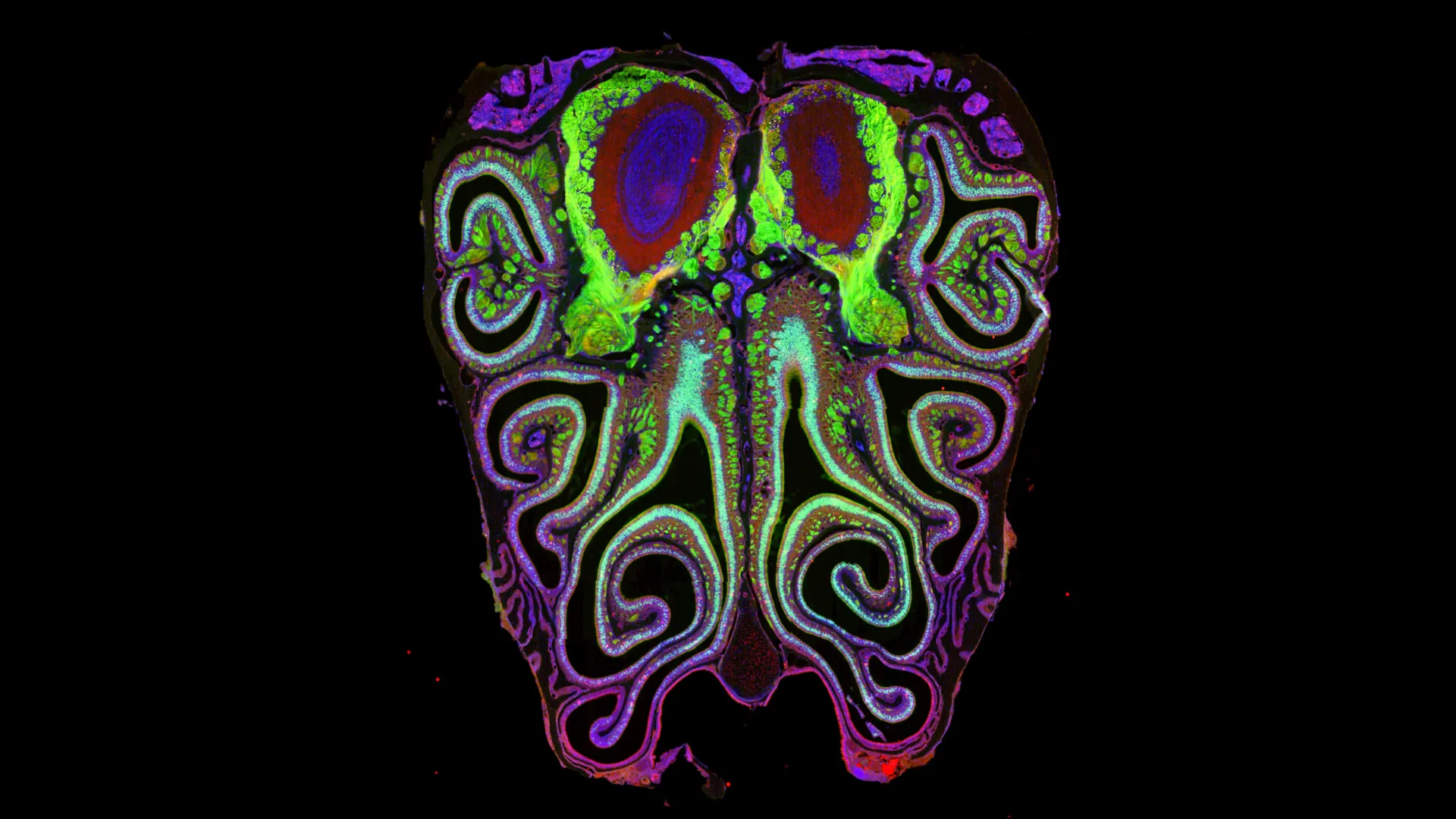
For years, scientists assumed that the cells in the nose that detect smell were scattered in a mostly random way. But in a recent study led by researchers at Harvard Medical School, a team took a closer look by studying millions of smell receptors in mice.
What they found was unexpected: these receptors aren’t random at all; they’re arranged in neat, overlapping stripes that stretch from the top to the bottom of the nasal cavity. This structure acts like a hidden map, where each stripe represents a group of neurons that detect specific types of odor molecules.
Even more exciting, this map inside the nose closely matches a similar pattern in the brain. That means that the way smells are sensed and how they are understood by the brain are tightly connected like two pieces of a puzzle that fit together perfectly.
Researchers also began to understand how this hidden map forms as animals develop. They discovered that a molecule called retinoic acid which helps control how genes are turned on and off plays an essential role in guiding smell neurons into their correct positions.
When the levels of this molecule were changed in the lab, the entire receptor map shifted, showing that this chemical helps shape the sense of smell from the very beginning.
So why does this matter? Understanding the basic structure of smell could help scientists find new ways to restore lost senses in people who can no longer smell due to injury or illness.
Right now, treatments for smell loss are limited and often don’t work well. But now that we know how the nose normally organizes smell information and connects it to the brain, researchers have a better roadmap for developing future therapies.
This discovery not only answers a long-standing scientific mystery it opens doors to future advances that might help people reclaim a sense many of us take for granted.
Leave a Reply