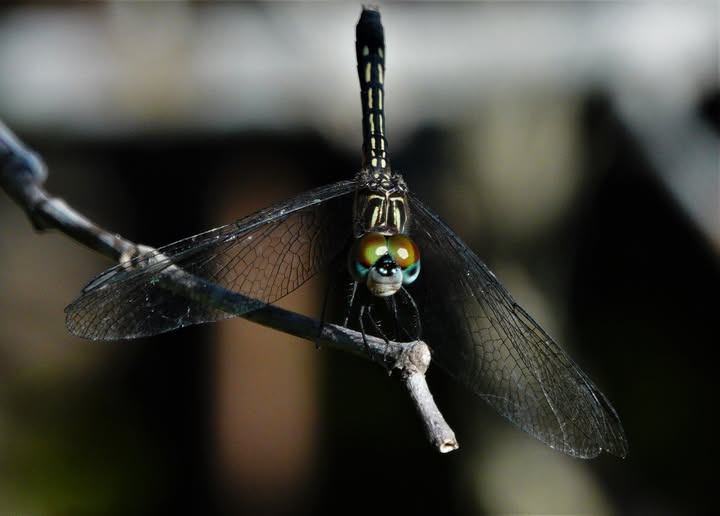
Scientists from Osaka Metropolitan University have discovered that dragonflies can see a type of light that humans cannot detect, giving them a unique visual advantage. While human vision is limited to a certain range of colors, dragonflies are able to perceive extremely deep red light, close to near-infrared.
This allows them to experience a broader visual world and detect details that are invisible to humans. The study highlights how even small insects can possess highly advanced sensory abilities that rival or exceed our own.
This ability comes from special proteins in their eyes called opsins, which are also present in humans. In people, these proteins allow us to see basic colors such as red, green, and blue. However, the researchers found that dragonflies have a modified version of these proteins that is sensitive to longer wavelengths of light.
One of these proteins responds to light at around 720 nanometers, which lies beyond normal human vision. According to the research, dragonflies and humans share a surprisingly similar biological mechanism for detecting red light, despite being very different species.
This finding is an example of parallel evolution, where unrelated organisms develop similar features independently. As the research team led by Professors Mitsumasa Koyanagi and Akihisa Terakita at OMU’s Graduate School of Science explains, this discovery unveils an extraordinary parallel in evolutionary biology.
“This is one of the most red-sensitive visual pigments ever found,” Professor Terakita said. “Dragonflies can likely see deeper into red light than most insects.”
The researchers also noted that this enhanced vision plays an important role in the survival of dragonflies. Because they fly at high speeds, they need to quickly identify other dragonflies, especially potential mates.
Their ability to detect subtle differences in light reflection helps them distinguish between males and females while in motion. This gives them a strong advantage in reproduction and survival within their environment.
Beyond biology, the findings have important implications for medicine and technology. Red and near-infrared light can penetrate deeper into the human body than other types of light, making them useful in medical treatments.
The researchers were able to modify the dragonfly’s light-sensitive proteins so they respond to even longer wavelengths and demonstrated that cells can be controlled using this light. This could be especially useful in optogenetics, a field where light is used to control cells inside the body.
Overall, the study shows how nature can inspire scientific innovation. By studying dragonflies, researchers may develop new tools for treating diseases and exploring the human body, proving that even the smallest creatures can lead to major breakthroughs in science and medicine.
Leave a Reply