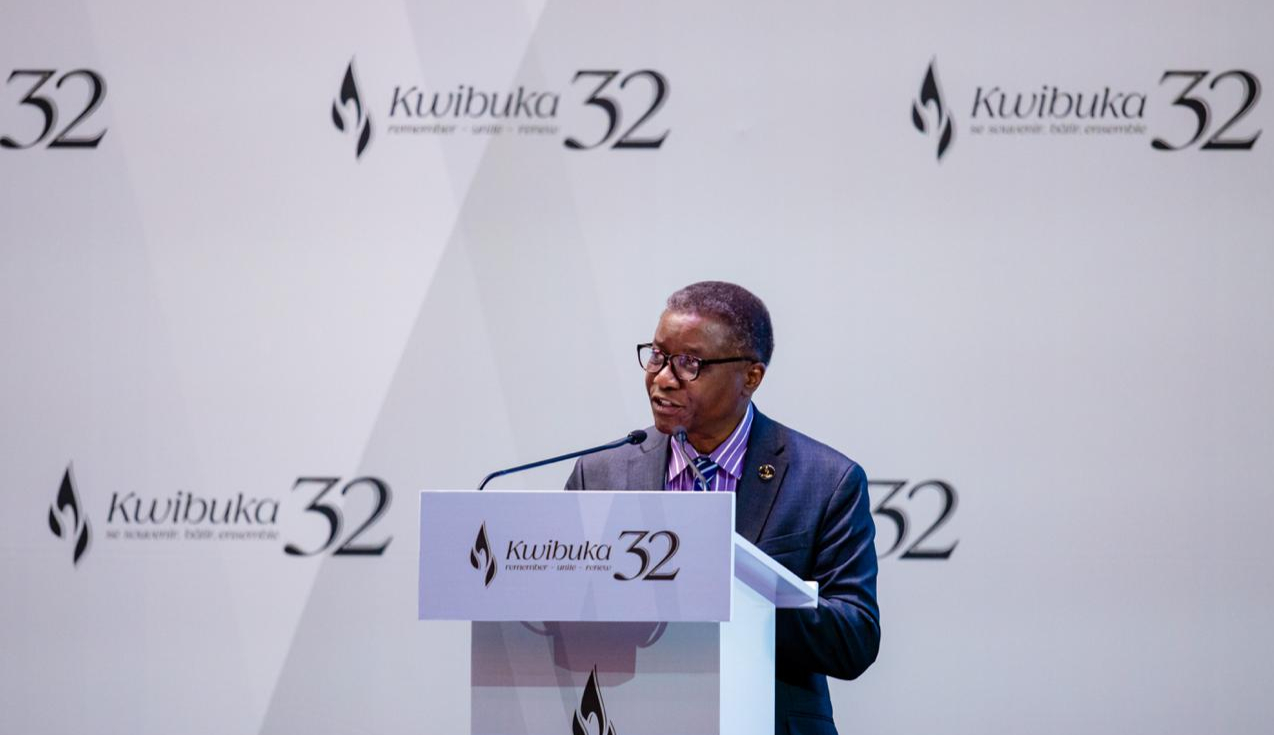
He made the remarks on Wednesday, April 8, during the International Conference on Genocide Prevention held at Intare Conference Arena, part of Rwanda’s 32nd commemoration of the 1994 Genocide against the Tutsi.
“It is with profound honour to be here in Kigali, speaking for the first time since my appointment in September last year,” Beyani said. “Genocide is the most heinous crime against humanity. Its essence is the extermination of people based on their identity.”
Beyani recounted his personal experience during the 1994 genocide. As an academic at the University of Oxford and a trustee at Oxfam, he received early reports of mass killings of Tutsis in Rwanda.
“Oxfam was among the first humanitarian organisations to acknowledge and denounce genocide against Tutsis,” he said.
During a July 1994 visit to Rwanda, he witnessed the aftermath firsthand, describing the sight of victims’ bodies in public spaces in Kigali as an experience that “shocked the core of my conscience as a human being.”
Drawing lessons from the tragedy, Beyani outlined the creation of his office as an early-warning mechanism within the UN, a direct response to the international community’s failure to prevent the 1994 Genocide against the Tutsi.
He emphasised that prevention requires both effective early-warning mechanisms and early action to protect civilians.
“Genocide is deliberately designed to effect mass execution. It takes systematic planning to execute it. It cannot occur without state failure or complicity,” Beyani said. “In 1994, the international community, including the United Nations, failed Rwanda. The early warning signs were there.”
“All these remind us that we must do more to protect people’s lives and reinforce preventive engagements and actions. The commitments to prevent that echo in the halls of international institutions must translate into effective prevention in the spaces where this is most needed. From the onset, we are required to set up not only effective early warning mechanisms, but also early action to save lives.
Beyani warned that rising xenophobia, hate speech, and the erosion of multilateral norms continue to threaten global peace. He called for coordinated efforts between the UN, regional organisations such as the African Union, the International Conference on the Great Lakes Region, IGAD, the East African Community, ECOWAS, and national institutions, as well as civil society, media, youth, and religious leaders.
“The genocide against the Tutsi started with words — the demonisation of an entire community group. We must put in place concrete measures to address and counter hate speech, because in its worst form, it is an indicator and trigger of the risk of genocide and other atrocious crimes,” he stated.
The conference also highlighted ongoing risks in the Great Lakes region, particularly in the Democratic Republic of the Congo. Senegalese General Babacar Faye, a former UNAMIR officer, compared the current situation in eastern DR Congo to pre-genocide Rwanda, noting continued ethnic targeting, militia activity, and insufficient international intervention.
Lawyer Innocent Nteziryayo and other experts cited massacres against the Banyamulenge community in DR Congo, tracing a pattern of discrimination and violence that persists decades after the Rwandan genocide. They warned that genocide ideology continues to spread, and that international silence risks repeating past failures.
“Reports are written, but followed by silence,” said Faye. “The international community had information about an imminent genocide, but lacked political will. Genocide does not wait. Impunity is the fertiliser of genocide. Hate speech must be punished.”
Survivors and researchers at the conference emphasised the need to translate lessons from Rwanda into action, ensuring accountability for perpetrators and protection for at-risk communities.
Yolande Mukagasana, a survivor and author, recalled decades of persecution against Tutsi and called out the UN’s inaction.
“The UN existed even in 1972, but it did not act. Today, Tutsi are being killed and persecuted in the Democratic Republic of the Congo. Urgent action is needed.”
Beyani concluded with a call for sustained global commitment: “As we remember the horrors of 32 years ago, let us redouble our efforts to build resilient societies by guaranteeing fundamental rights and freedoms. The best way to honour the victims and survivors of the 1994 Genocide against the Tutsi is to ensure that no one else endures this most heinous of crimes. This is both a call and an obligation for all of us.”
Leave a Reply