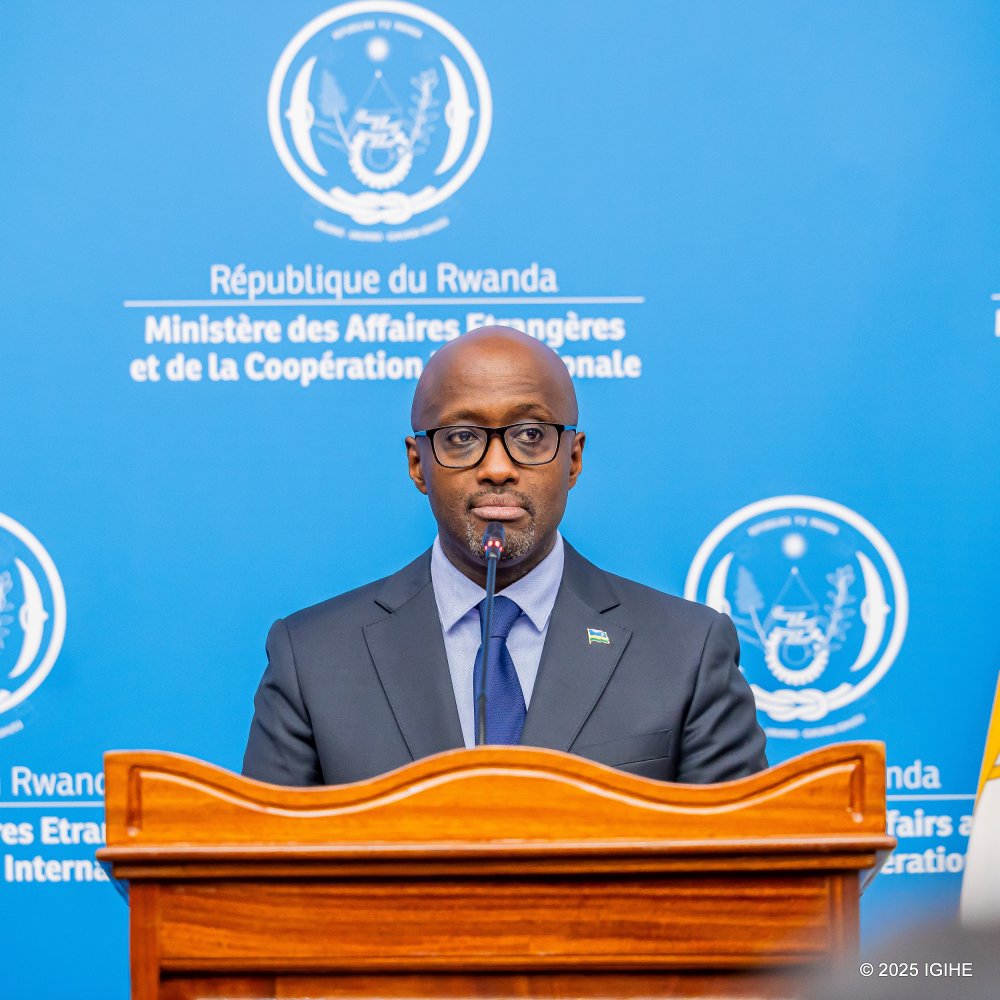
The minister was responding to Congolese government spokesperson Patrick Muyaya, who had downplayed the threat posed by the militia group formed by the perpetrators of the 1994 Genocide against the Tutsi who fled to the DRC.
Muyaya had questioned whether members of the FDLR could still pose a threat 32 years later, calling the group an “eternal pretext” in regional tensions.
Responding in detail, Nduhungirehe rejected that argument outright.
“The misleading propaganda of the Congolese government on the issue of the genocidal FDLR nevertheless has its limits,” the minister wrote.
He recalled that on March 21, 2024, during the first ministerial meeting under the Luanda Process, then DRC Foreign Minister Christophe Lutundula had committed to presenting a “plan for the neutralisation of the FDLR.”
“In the final communiqué of that meeting, it was even specified that ‘consequently’ to the neutralisation of the FDLR, Rwanda would lift its defensive measures,” Nduhungirehe stated.
However, he pointed to what he called a sudden reversal only days later.
“We were surprised to hear, two days later in a press conference in Kinshasa, the same Christophe Lutundula claim that the FDLR did not exist,” he said.
The minister also cited a planned 2024 operation by the Congolese armed forces (FARDC), coordinated with the United States and aimed at targeting FDLR positions, describing it as a total failure.
“This military operation was a total failure, for the simple reason that a FARDC general had informed his FDLR friends in advance,” Nduhungirehe stated, adding that the development had angered international partners.
Despite that setback, he noted that military and intelligence experts from Rwanda, the DRC and mediator Angola later adopted a Concept of Operations (CONOPS) in Luanda on October 31, 2024, focused on neutralising the FDLR.
According to Nduhungirehe, the CONOPS became a key pillar of subsequent peace understandings.
“The neutralisation of the FDLR is therefore a central element of the Washington Agreements and for a lasting peace in eastern DRC,” he wrote.
But he questioned Kinshasa’s commitment, noting that coordination meetings between FARDC and FDLR commanders took place on the very day the CONOPS was endorsed.
“This demonstrates the lack of political will in Kinshasa on the FDLR issue,” he argued.
Addressing Muyaya’s assertion that the group’s age diminishes its relevance, Nduhungirehe dismissed the reasoning as flawed.
“This eternal argument about the age of FDLR members is one of the most absurd and ridiculous there is,” he said, adding that the group “regularly recruits new members on the basis of its genocidal ideology.”
Muyaya had claimed that the real drivers of instability in eastern DRC are natural resources, including gold and coltan, rather than the FDLR.
Earlier this month, President Paul Kagame dismissed claims that Rwanda was targeting DRC minerals, insisting that the country’s concerns were primarily about security and the FDLR’s genocidal ideology.
“If we were in Congo for minerals, we would be a hundred times richer than we are now […] the threats coming from Congo related to our security have materialised several times. You just don’t want to see it, you don’t want to hear it,” he stated during the 20th edition of Umushyikirano, Rwanda’s National Dialogue Council.
Leave a Reply