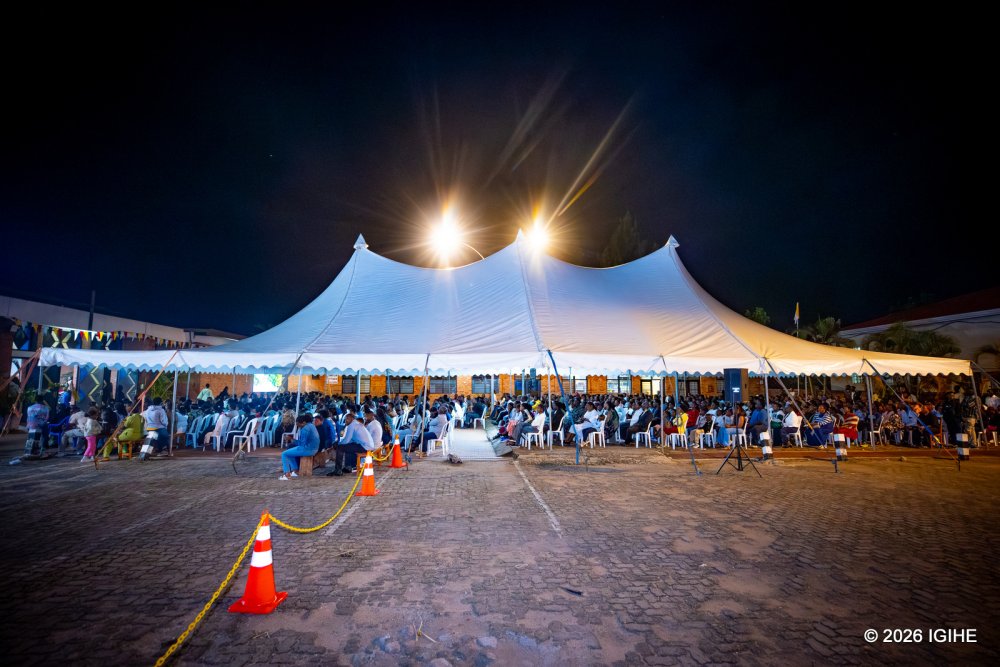
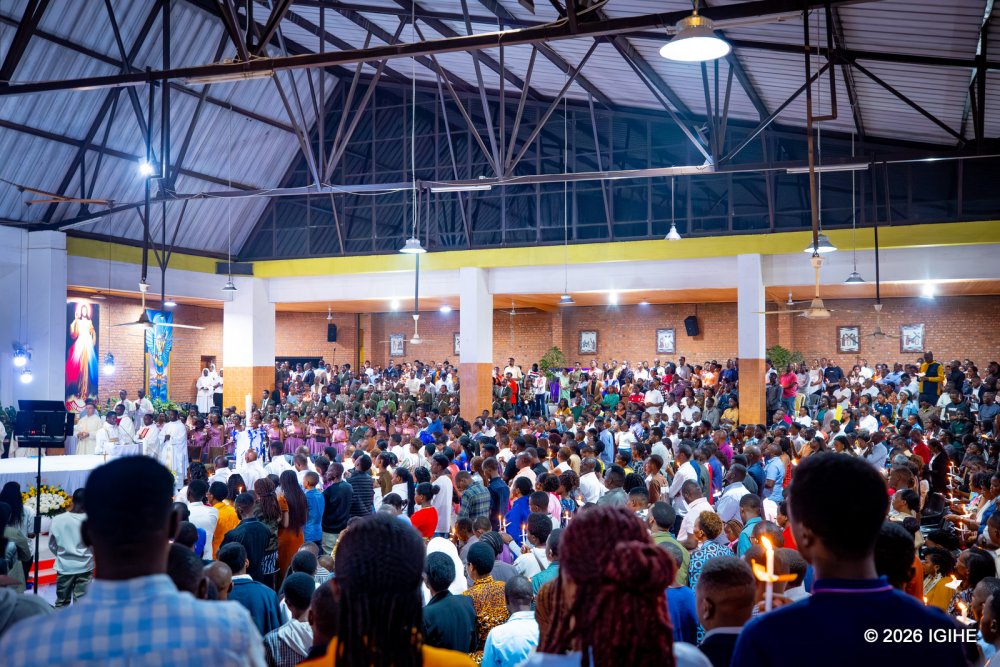
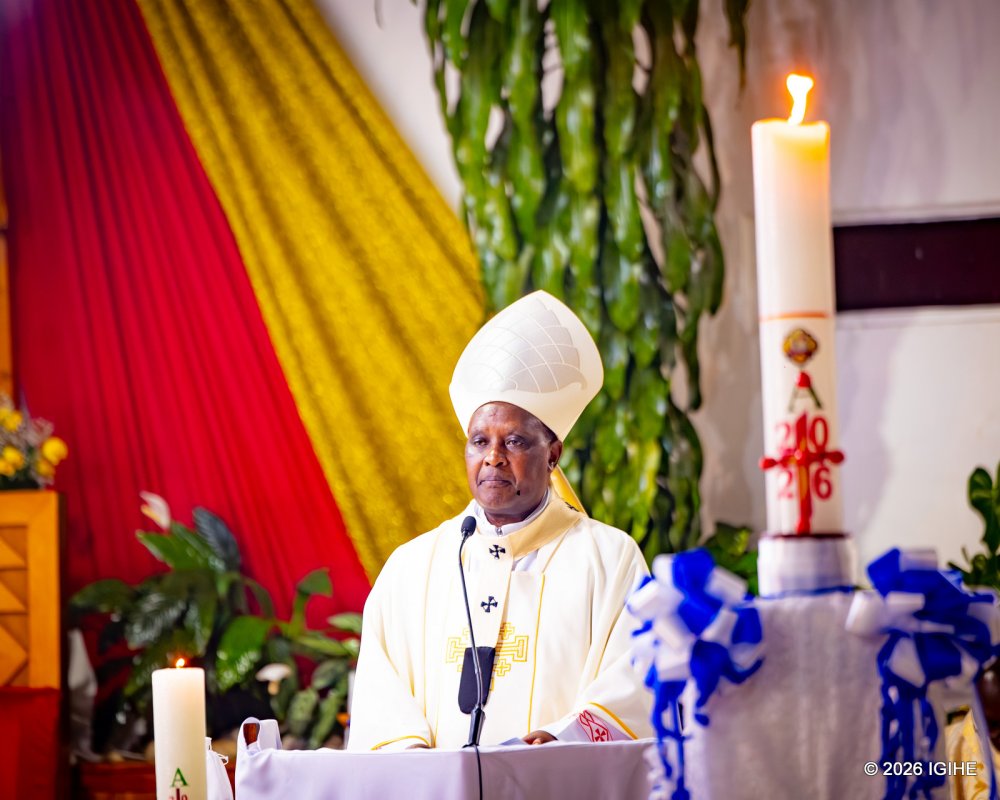
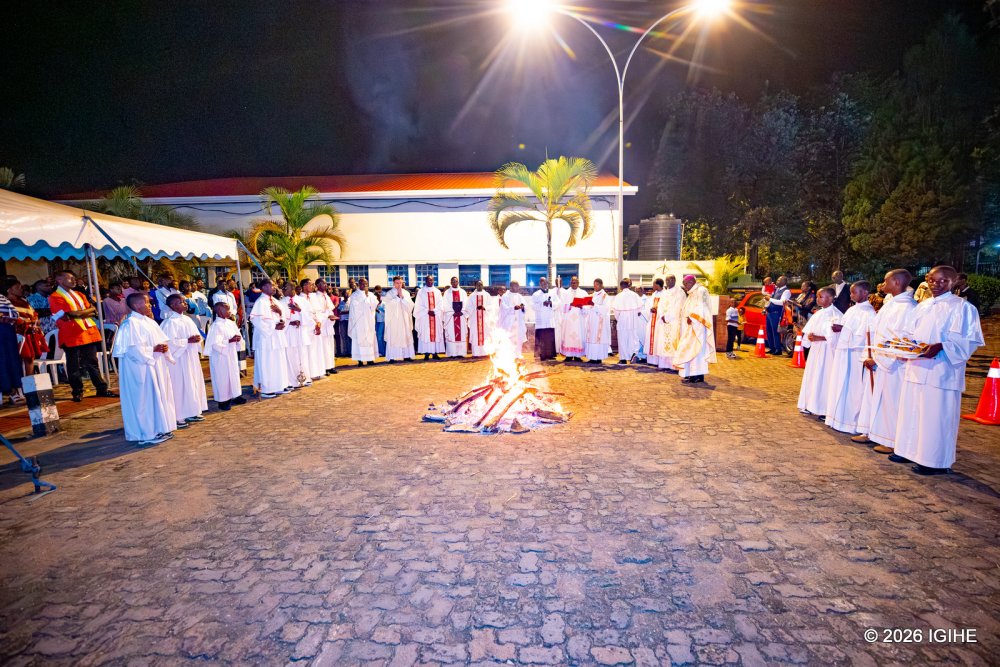
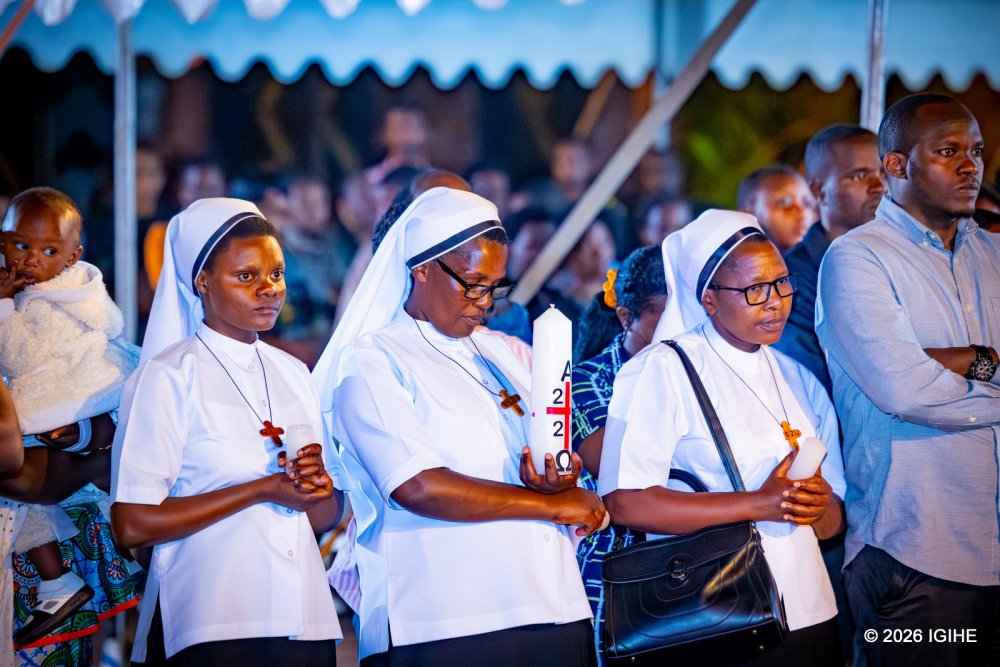
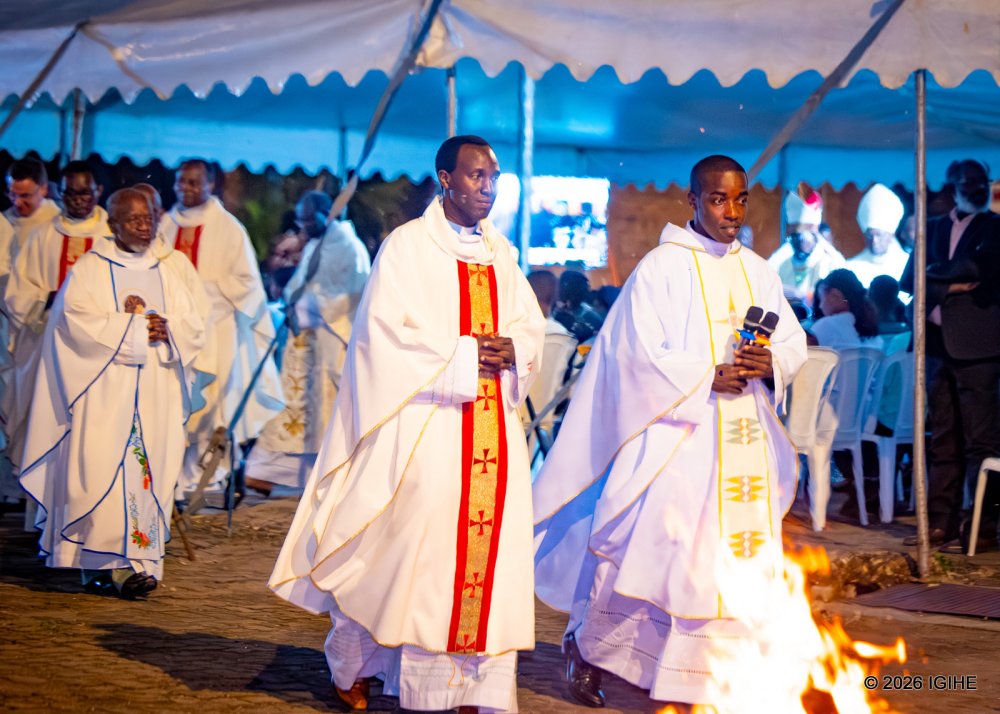
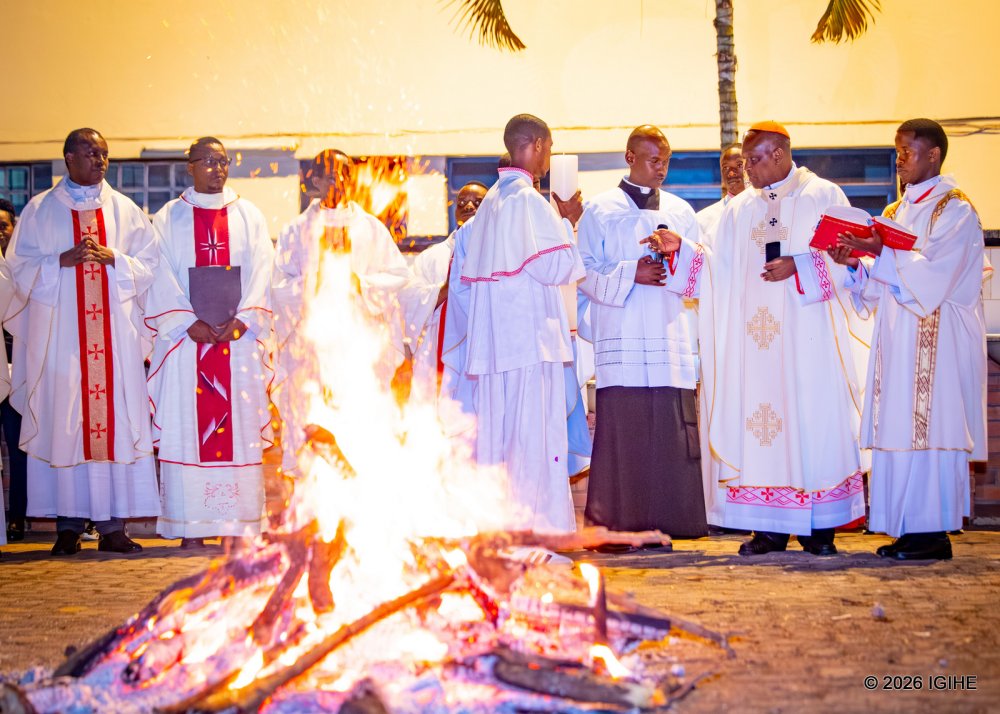
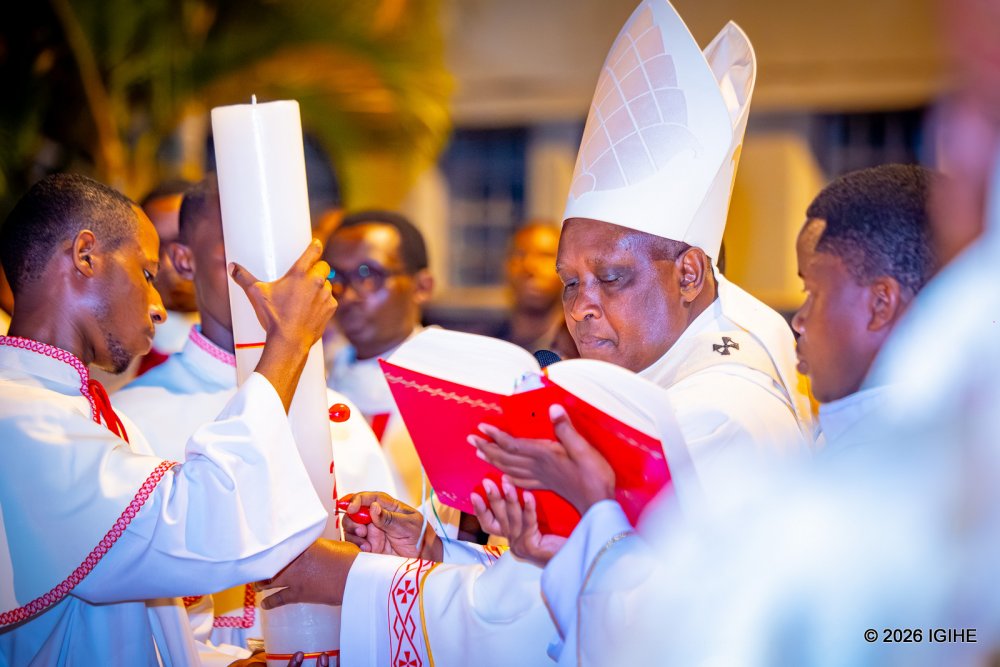
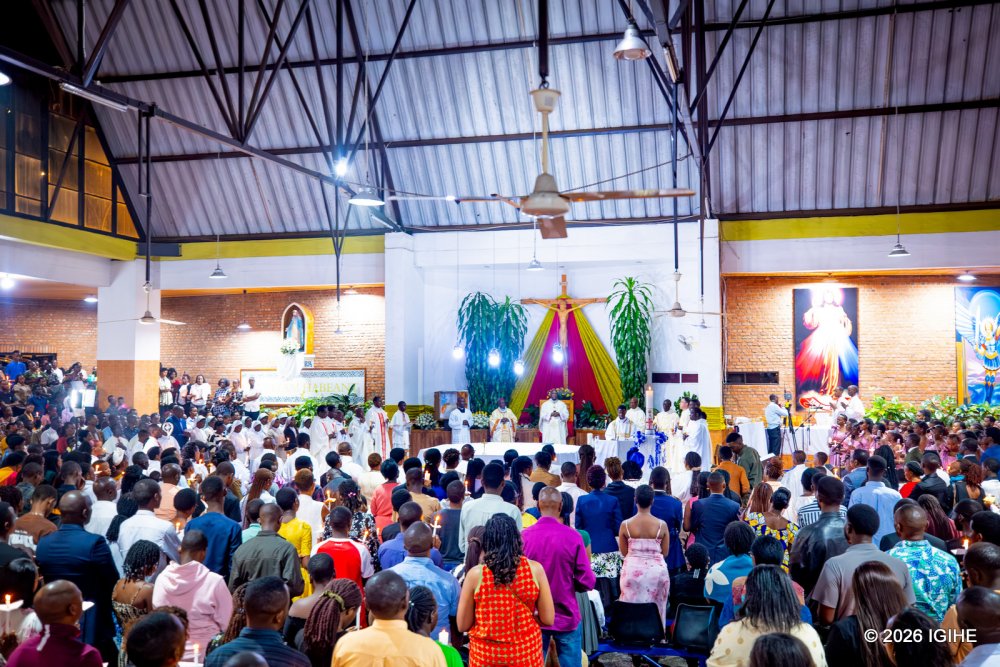
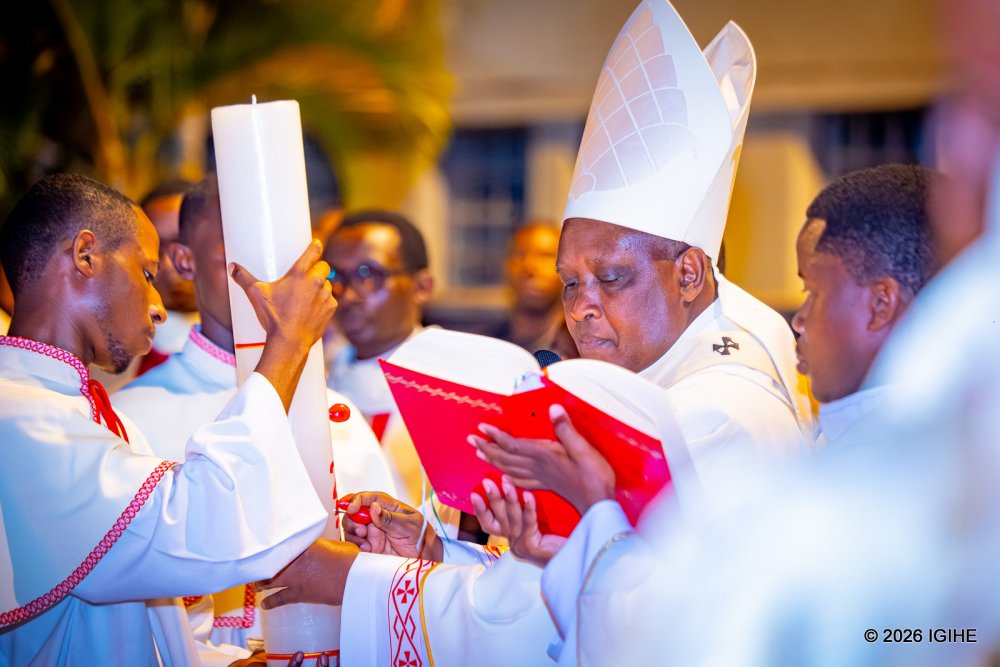
The Archbishop of Kigali, Antoine Cardinal Kambanda, delivered this message during the Easter Vigil Mass held at Saint Michel Cathedral Parish in Kigali.
The service brought together believers preparing to celebrate Easter, one of the most significant feast in the Catholic Church, which commemorates the resurrection of Jesus Christ.
In his homily, Cardinal Kambanda stressed that faith remains the foundation of all aspects of life, noting that many of today’s challenges, including family breakdowns and conflicts around the world, stem from a lack of strong belief.
“Faith is the foundation of everything,” he said, urging Christians to remain rooted in their beliefs and to become true witnesses of Christ in their daily lives.
He further encouraged the faithful to let the spirit of Easter strengthen love among them, helping them resist violence and wrongdoing. He called on Christians to embrace the light of Christ and turn away from sin and hatred.
The Cardinal also warned against growing materialism, saying that the desire for worldly possessions is increasingly overshadowing love for God. He reminded believers that one cannot serve both material wealth and God at the same time.
As Rwanda approaches the commemoration of the 1994 Genocide against the Tutsi, Cardinal Kambanda reflected on its connection to faith, describing the tragedy as a sign of moral failure where true Christian values were lacking.
He drew parallels between the suffering of genocide victims and that of Jesus Christ, emphasizing the importance of remembrance and compassion.
He urged Christians to continue honoring the victims while also supporting survivors with care and love, noting that their needs remain significant despite their survival.
Cardinal Kambanda also called on all believers to pray for peace in Rwanda, the region, and the world, so that people may live together in harmony and stability.
Christians in Kigali have been called upon to deepen their faith as they celebrate Easter.Christians were also encouraged to let the spirit of Easter strengthen love among them, helping them resist violence and wrongdoing. In his homily, Cardinal Kambanda stressed that faith remains the foundation of all aspects of life. Clergy attended the Easter Vigil Mass at Saint Michel Cathedral Parish in Kigali in large numbers.
Speaking on his social media platform, Truth Social, Trump declared, “We got him,” revealing that the rescued officer, a highly respected colonel, had been trapped deep in Iran’s mountainous terrain after the aircraft went down two days earlier. Despite sustaining injuries, the pilot is expected to recover.
According to Trump, the rescue followed hours of intense planning and coordination, with military leaders closely monitoring the pilot’s location while he remained behind enemy lines. He praised the operation as a moment of national pride, highlighting the professionalism and determination of US forces involved.
Reports indicate that the mission involved a specialized commando unit backed by heavy air support and included a firefight during the extraction. While the pilot has been secured, officials said the operation remained sensitive until all forces safely exited the area.
This marks a rare instance where two US pilots have been rescued separately from hostile territory following the same incident. The first pilot had been recovered earlier, but confirmation was delayed to avoid compromising the second mission.
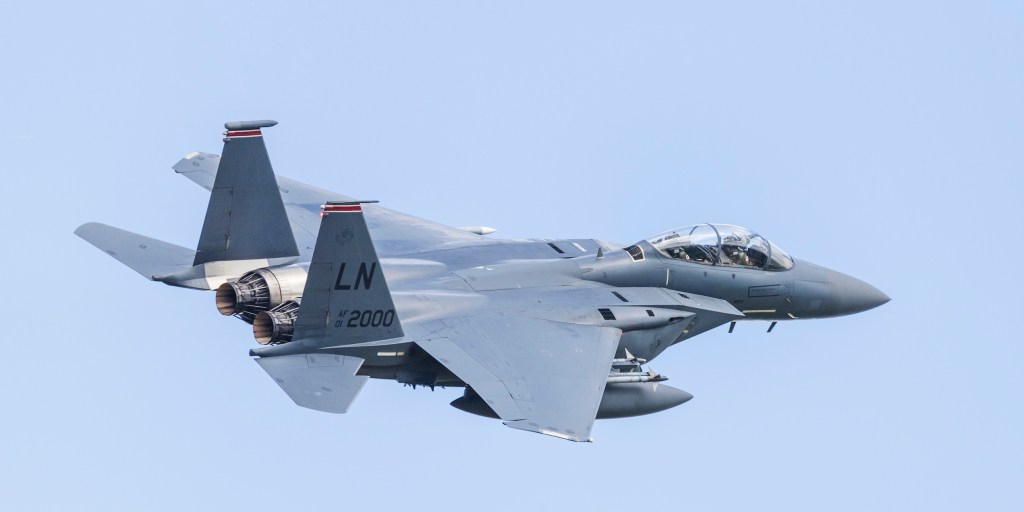
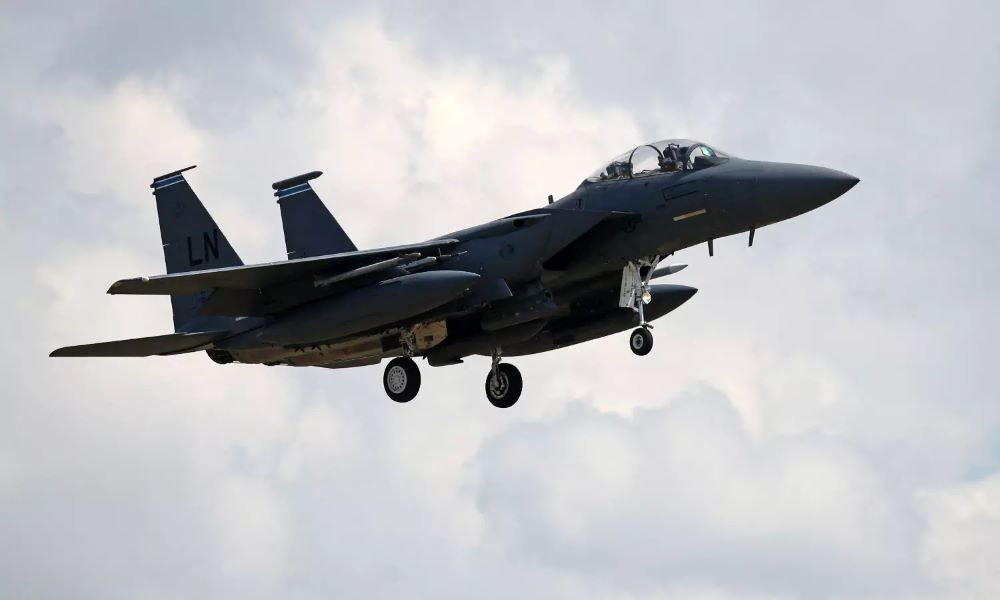
The incident stems from escalating tensions after Iranian forces reportedly shot down the US F-15 jet, as well as an A-10 Warthog aircraft in the region on Friday. Both sides had launched search efforts for the missing crew members in the aftermath.
U.S. officials confirmed on Friday that two U.S. rescue helicopters, including a UH-60 Black Hawk, which undertook the search-and-rescue operations for the jets, were also struck.
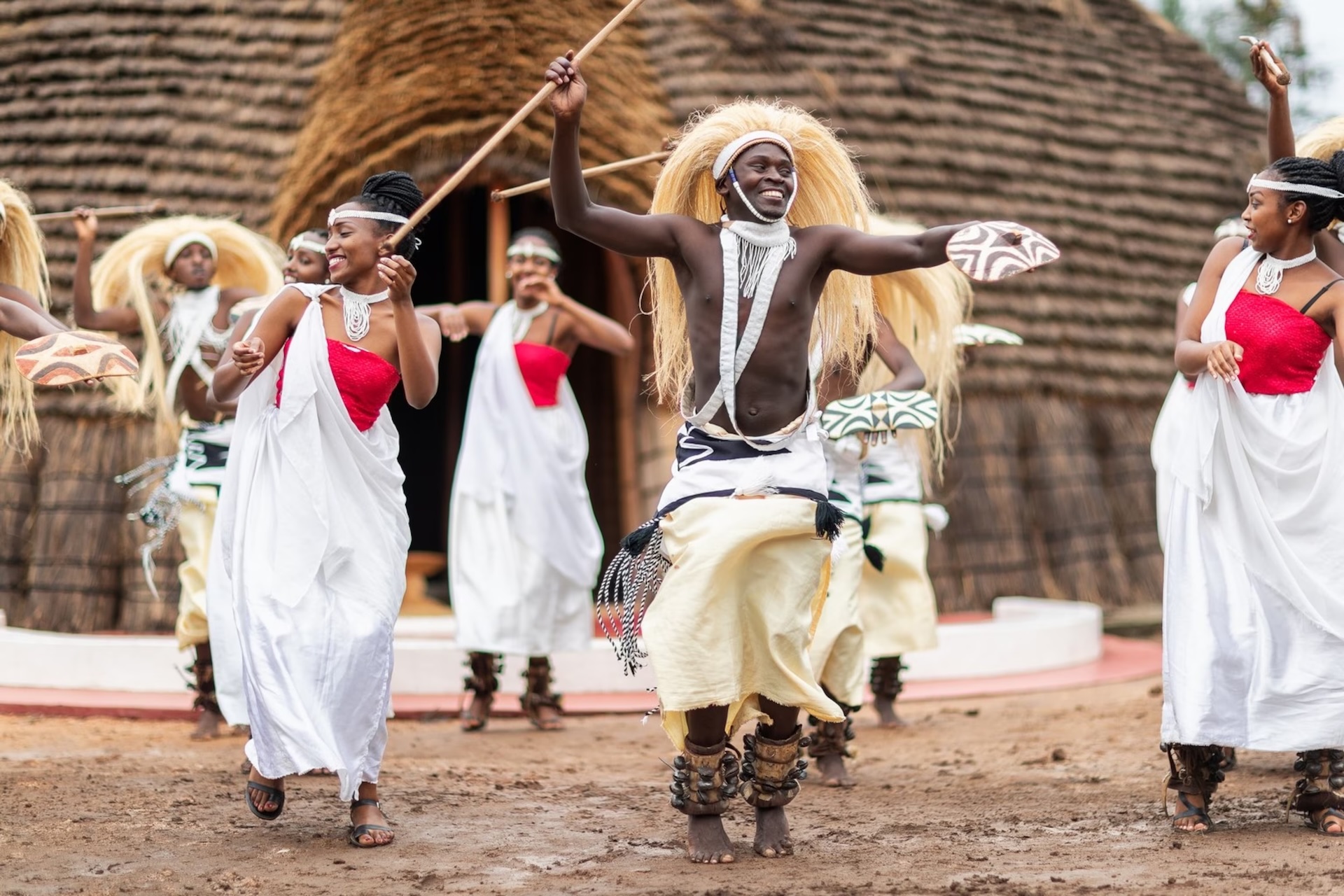
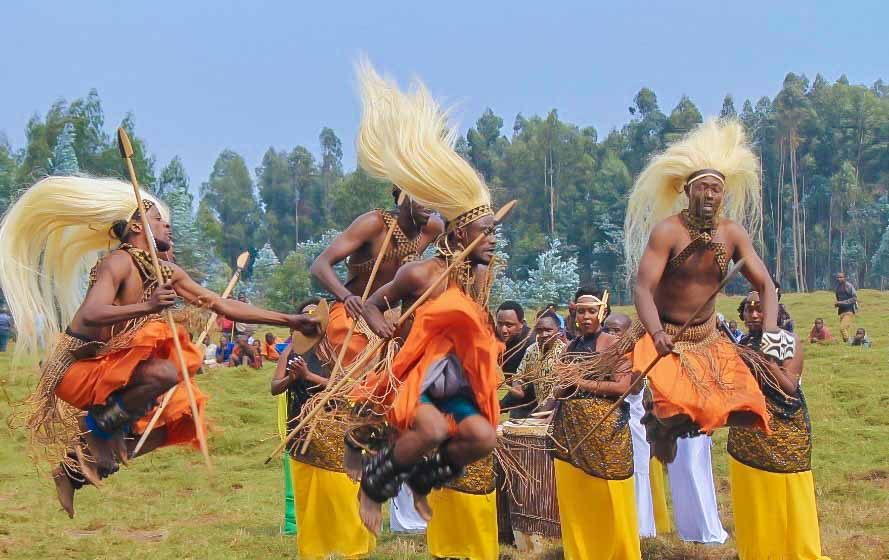
The roots of the Intore Dance trace back to the royal courts of Rwanda. It was originally performed exclusively for the king and his court, a privilege given only to the most skilled dancers. The performers, known as “Intore,” underwent rigorous military training, learning not only the techniques of combat but also the art of dance.
It was believed that these dances, with their swift, dramatic jumps and rhythmic movements, were a way to honor the strength and bravery of warriors. The dance itself was a display of grace, agility, and unity; each move was both a tribute to the royal family and a representation of Rwanda’s values of resilience and unity.
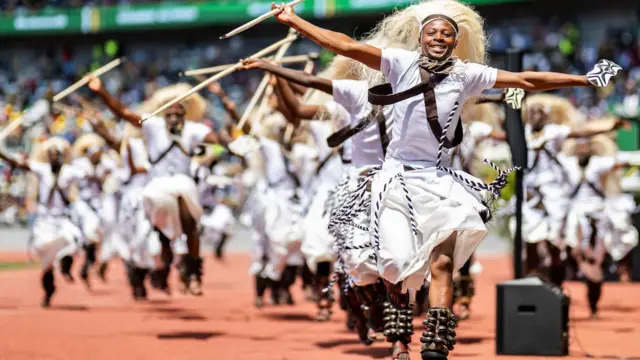
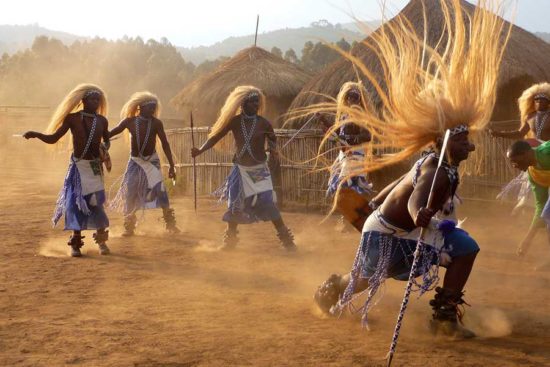
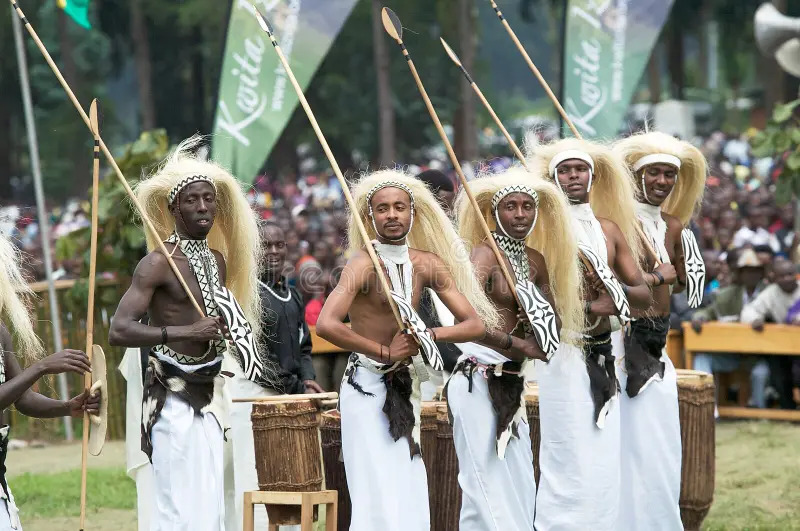
The spectacle of the Intore Dance is impossible to ignore. Dancers, dressed in stunning costumes adorned with grass wigs and holding wooden spears, leap into the air, their feet striking the ground with the power of a thousand drums.
The dances tell stories of warriors returning from battle, of hunting, and of the timeless bond between the people and the land. The rhythmic sounds of drums, the chanting of lyrics passed down through generations, and the elegance of the performers all come together to create an unforgettable experience.
Today, Intore Dance remains a central part of Rwanda’s cultural celebrations and was inscribed on UNESCO’s intangible cultural heritage in 2024. Visitors to Rwanda can witness these incredible performances at cultural villages, museums, and even at lodges and hotels throughout the country.
One of the best places to experience this live performance is the Gorilla Guardians Village in Musanze, where visitors are welcomed by local dancers who bring the ancient traditions to life.
The National Museum of Rwanda also offers regular performances, allowing both locals and tourists to connect with Rwanda’s history and culture.
The longest-living traditional Rwanda dance reserved for elite royal soldiers.Witness the strength, grace, and tradition of the Intore, the ‘Chosen Ones’ of Rwanda.In ancient times, the Intore Dance was performed exclusively for the king, showcasing Rwanda’s bravest warriors.Experience Rwanda’s heart through the powerful leaps and rhythms of the iconic Intore Dance. The vibrant Intore dance at Gorilla Guardians Village in Musanze and the National Museum of Rwanda, where tradition comes to life for both locals and visitors alike.
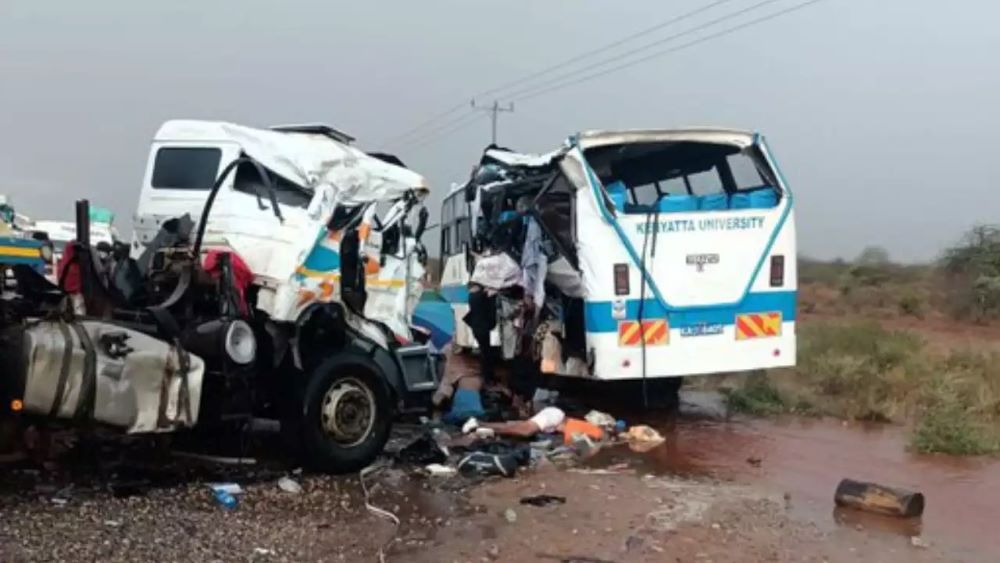
Police said the incident occurred at around 9:30 p.m. local time (1830 GMT) and involved a 10-seater minibus, locally known as a matatu, which was traveling from the lakeside town of Naivasha toward Nakuru City.
According to police, the minibus rammed into a stalled truck that had been parked along the highway due to a mechanical problem.
The latest incident brought the total number of people killed in separate accidents on Friday to 20, which includes 16 passengers and four riders, police said, adding that 27 others were injured.
According to police, fatal accidents are common in Kenya due to reckless driving, dangerous overtaking, drunk driving, and failure to use helmets.
An estimated 4,000 Kenyans die in road accidents annually despite concerted efforts by the state and the private sector to promote road safety, according to the National Transport and Safety Authority.
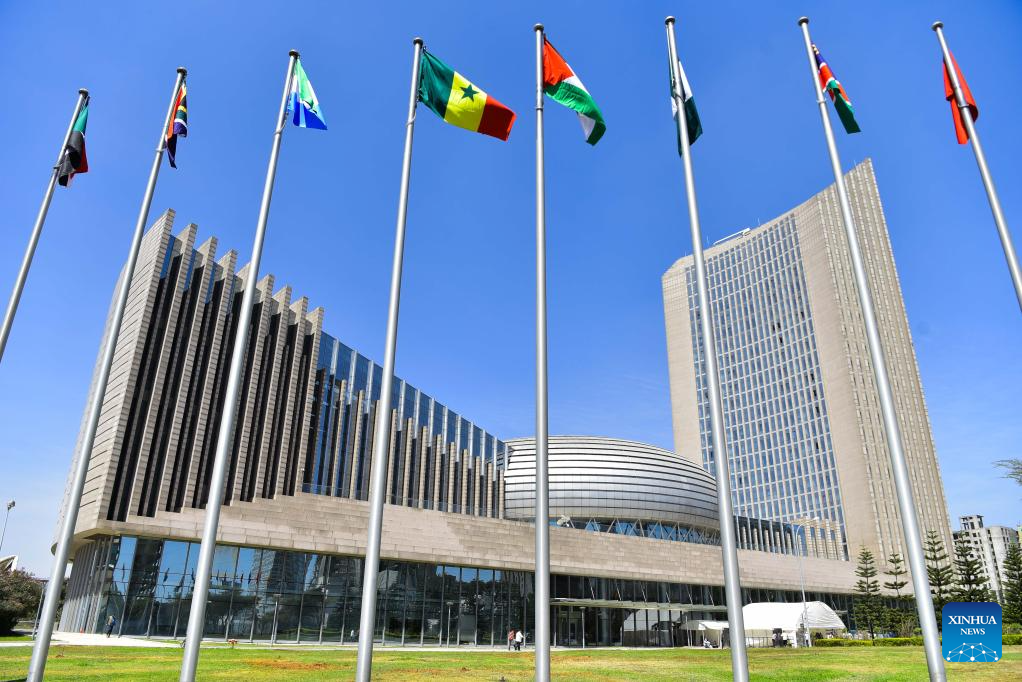
AU Commission Chairperson Mahmoud Ali Youssouf said in a statement that the initiative “constitutes a timely and constructive contribution to ongoing international efforts to de-escalate tensions and advance a political and diplomatic pathway.”
He said the initiative’s “emphasis on an immediate cessation of hostilities, the protection of civilians, respect for international humanitarian law, and the safeguarding of maritime security reflects key elements required to contain the current crisis.”
Youssouf reiterated his “deep concern” over the continued escalation in the Gulf and Middle East region.
He underscored that the effects of the conflict are already being felt globally, including on energy supply chains, food systems, and economic stability — particularly in Africa, a continent already confronting multiple and intersecting challenges.
Calling for restraint, urgent de-escalation and sustained engagement, the AUC chief stressed that all parties must act fully in accordance with international law and the United Nations Charter to safeguard international peace and security.
“A durable resolution can only be achieved through dialogue and negotiated solutions,” he added, stressing the AU’s readiness to work with international and regional partners for peace and stability in the region.
One pilot from the two-seat F-15 has been rescued, but the other remains missing. The A-10 Warthog reportedly managed to reach Kuwaiti airspace, where the lone pilot ejected and escaped.
U.S. officials later confirmed that two U.S. rescue helicopters, including a UH-60 Black Hawk, which undertook the search-and-rescue operations for the jets, were also struck.
The consecutive losses of U.S. aircraft came shortly after U.S. President Donald Trump’s claim that Iranian forces “can’t do a thing about” U.S. planes flying over Tehran.
Scrambling for pilot
This incident is the first known case of a U.S. warplane being downed inside Iranian territory and the fourth F-15 lost since the United States and Israel launched large-scale strikes on Iran on Feb. 28.
Crews were racing to locate the second pilot of the downed jet, which was believed to have crashed in Iran’s southwestern Kohgiluyeh and Boyer-Ahmad province, near the border with Iraq, according to local authorities.
Iran’s Revolutionary Guard Corps (IRGC) was combing an area near where the pilot’s plane came down in southwestern Iran, and the governor of the province said that anyone who captured or killed the pilot would be “specially commended,” reported Iran’s semi-official news agency ISNA.
A television channel in the province advised citizens who encounter downed U.S. pilots to keep them alive and bring them to authorities for a “prize,” reversing earlier instructions that had encouraged harming them, NewsNation reported.
A reward of 10 billion tomans (6,600 U.S. dollars) has been set to find the pilot, reported the Iranian news outlets.
After weeks of relentless U.S. airstrikes, Iranians posted jubilant messages online celebrating the downing of the U.S. aircraft. Iran’s Parliament Speaker Mohammad Baqer Qalibaf wrote on X that what had begun as a military campaign had now been transformed into a hunt for their pilots.
Israel’s state-owned Kan TV News reported that Israel is assisting the United States with intelligence in locating the pilot.
Meanwhile, Israel’s Channel 12 reported that the country had delayed planned strikes in the search area, citing Israeli officials. The Israel Defense Forces has not confirmed these reports independently.
“Miscalculation”
IRGC said Friday that the aircraft was hit by advanced air defense systems operated by its aerospace division.
Earlier on Wednesday, Trump said that Iran’s drone and missile capabilities had been “decimated”. While he claimed that the U.S. military had achieved “total air dominance” over the region, military experts suggested that air superiority does not mean that there are no threats.
Iran has bolstered its defenses by constructing extensive underground missile facilities, networks of tunnels, and fortified bunkers across the country, said Federico Borsari, a non-resident fellow with the Transatlantic Defense and Security Program at the Center for European Policy Analysis. “It is quite possible that some Iranian air defense assets are still operational and hidden and concealed in many locations across the country.”
The potential that a U.S. pilot remains alive and at large deep inside Iran has heightened the pressure on Washington in a war that has struggled to secure strong backing from the American public, according to opinion polls.
In a phone interview with The Independent, a British online newspaper, Trump said he hopes that’s “not going to happen” if Iranian forces find the missing airman.
Iran has rejected a U.S. proposal for a 48-hour ceasefire, the semi-official Fars news agency reported on Friday.
The source added that Washington has stepped up its diplomatic efforts to secure a ceasefire, particularly after an Iranian strike targeted a U.S. “military forces depot” on Kuwait’s Bubiyan Island.
According to the agency, assessments suggest that the proposal was put forward following an intensification of the crisis in the region and “serious problems” for U.S. forces resulting from their country’s “miscalculation” of Iran’s military capabilities.
U.S. officials later confirmed that two U.S. rescue helicopters, including a UH-60 Black Hawk, which undertook the search-and-rescue operations for the jets, were also struck.
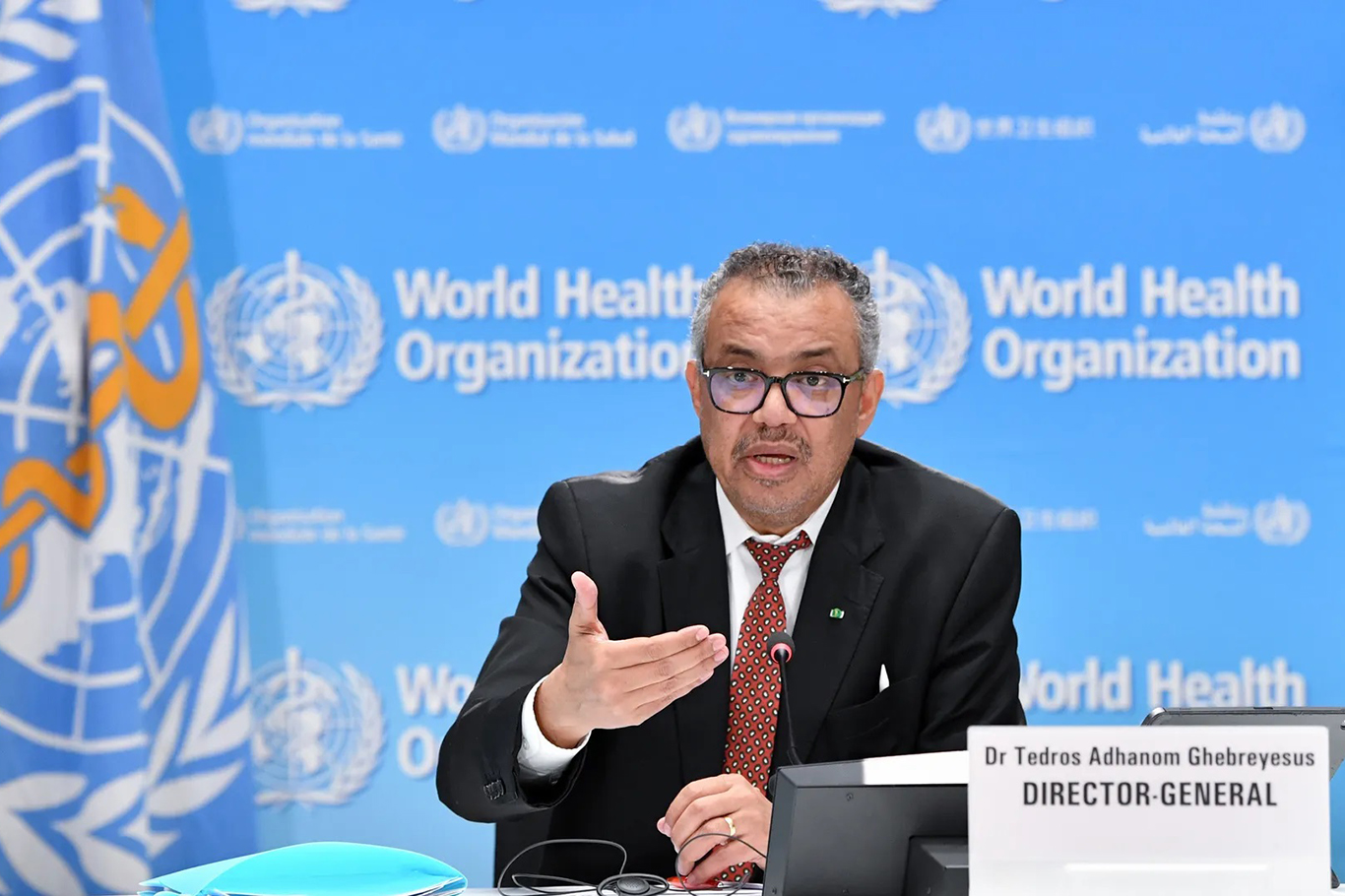
Health systems in the affected countries are “under severe strain” following weeks of intensified violence, Tedros said, adding that the WHO has launched a 30.3 million U.S. dollar flash appeal to support its health response to the escalating conflict in the Middle East, with a focus on the five countries.
The appeal, covering the period from March to August 2026, aims to sustain essential health services and trauma care, strengthen disease surveillance and early warning systems, and enhance mass casualty management, as well as national readiness for chemical, biological, radiological and nuclear emergencies, Tedros noted.
According to the WHO, as of March 31, the ongoing hostilities in the Middle East have triggered the displacement of more than 4 million people, with over 3,300 deaths and 30,000 injuries.
World Health Organization (WHO) Director-General Tedros Adhanom Ghebreyesus said on Friday in a social media post that urgent support is needed for the health systems of five countries affected by the conflict in the Middle East
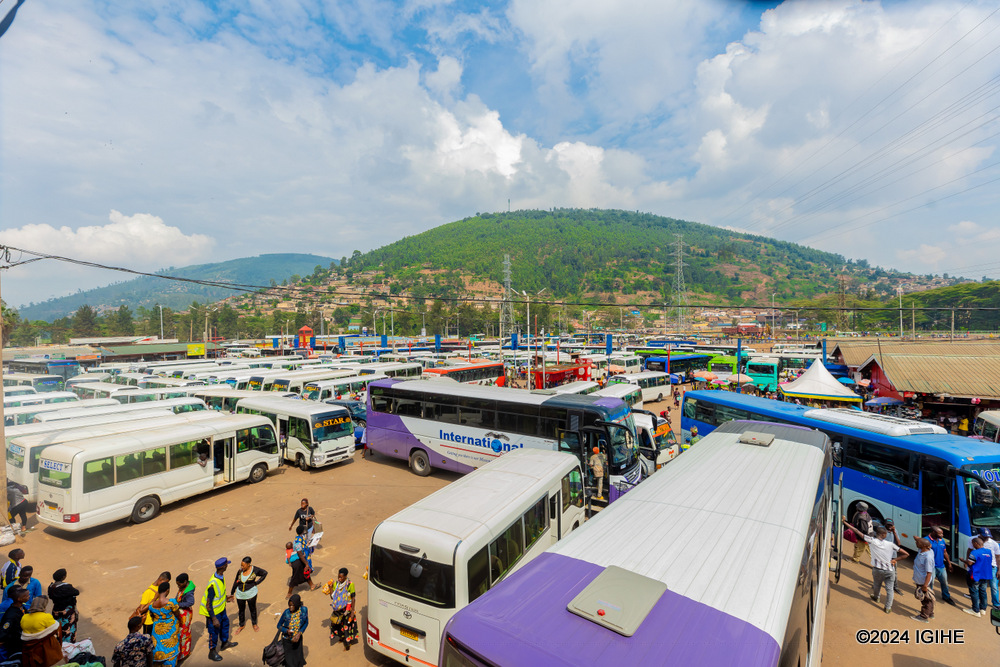
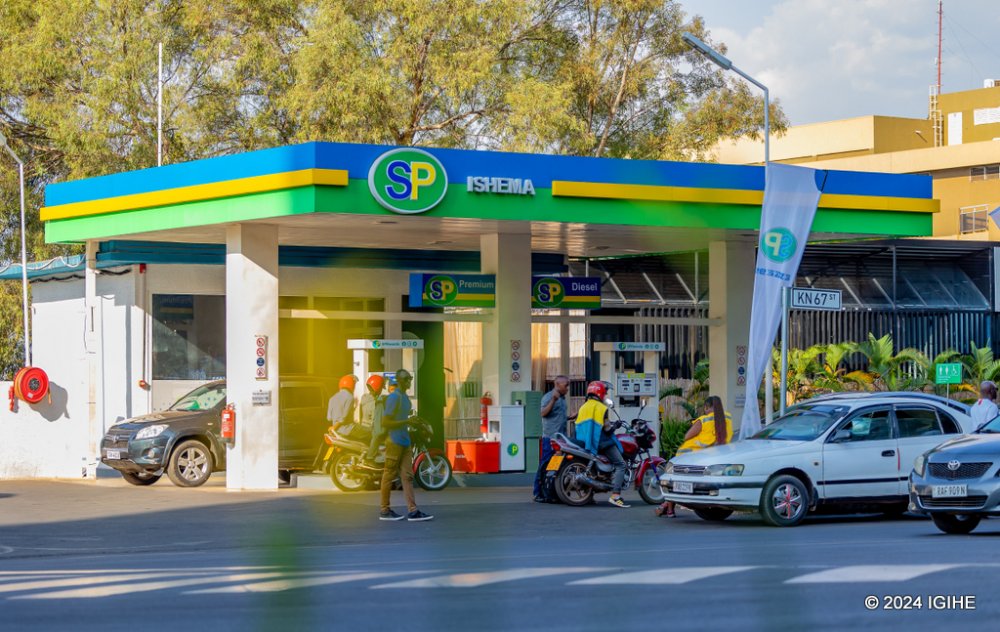
The changes come in response to a sharp rise in fuel prices, which recently reached historic levels in Rwanda. For the first time, both petrol and diesel exceeded Rwf 2,000 per litre, with petrol priced at Rwf 2,303 and diesel at Rwf 2,205.
Under the revised pricing structure, passengers in Kigali will now pay Rwf 59.28 per kilometre, while intercity travels will be charged Rwf 41.58 per kilometre.
Currently, the most expensive route in the country is from Nyabugogo to Kamembe via Huye, with a fare of Rwf 11,445. This route was not among those listed in the 2024 fare structure.
Passengers traveling from Nyabugogo to Pindura will now pay Rwf 10,930, up from the previous Rwf 8,070.
For those heading from Nyabugogo to Kamembe via Karongi, the fare has increased to Rwf10,296. Meanwhile, passengers traveling from Muhanga to Kamembe via Huye will pay Rwf 9,603, compared to the previous Rwf 7,090.
The fare from Nyabugogo to Mushubi has risen to Rwf 9,524 from Rwf 7,032. Similarly, passengers traveling from Rubavu to Kamembe will now pay Rwf 9,009, up from Rwf 6,652.
Other updated fares include Rwf 4,950 for the journey from Rubavu to Karongi, Rwf 4,851 from Nkomero to Kirambo, and Rwf 5,881 for passengers traveling from Gakeri to Nyamasheke.
The last adjustment to fuel prices was made on March 4, 2026, when petrol was priced at Rwf 1,989 per litre and diesel at Rwf 1,948 per litre.
In a statement released on April 3, 2026, RURA indicated that the new prices will take effect from April 4 at 6:00 a.m.
“These adjustments reflect the prevailing international market trends as well as government measures to mitigate the impact of global price fluctuations,” reads the statement.
“The public is encouraged to plan travel efficiently, use public transport and avoid unnecessary trips and in order to reduce fuel consumption,” the statement adds.
RURA also noted that the changes in fuel prices have led to a revision of the base fare in public transport. In the City of Kigali, passengers will now pay Rwf 59.28 per kilometre, while intercity travels will cost a passenger Rwf 41.58 per kilometre.
As of April 3, 2026, the price of a barrel of crude oil on the international market had reached $112.4 up from about $70.
The ongoing conflict involving the United States, Israel, and Iran, now entering its second month, has led to the blockage of the Strait of Hormuz, a critical passage through which 20% of the world’s daily oil supply passes.
On April 3, 2026, Prime Minister Dr. Justin Nsengiyumva told members of the press that the situation is already impacting Rwanda’s economy.
“This issue is affecting international trade, particularly in energy and transport, and has already caused noticeable changes in global market prices, especially for petroleum products and gas,” he said.
He further explained that the conflict is disrupting Rwanda’s exports, with some trade routes, including those to the United Arab Emirates, already affected.
Imports are also impacted, as rising global prices are expected to translate into higher costs within Rwanda.
“These are some of the effects we are observing that could impact our national economy. It is projected that global economic growth could decline from 3.3% to 2.7%. This will also contribute to rising prices in Rwanda, meaning it will affect nearly every Rwandan. We must be prepared, but without panic,” he added.
RURA has announced new fuel prices, with the cost of petrol rising to Rwf 2,303 per litre, an increase of Rwf 314. Diesel has also gone up to Rwf 2,205 per litre, reflecting an increase of Rwf 257.
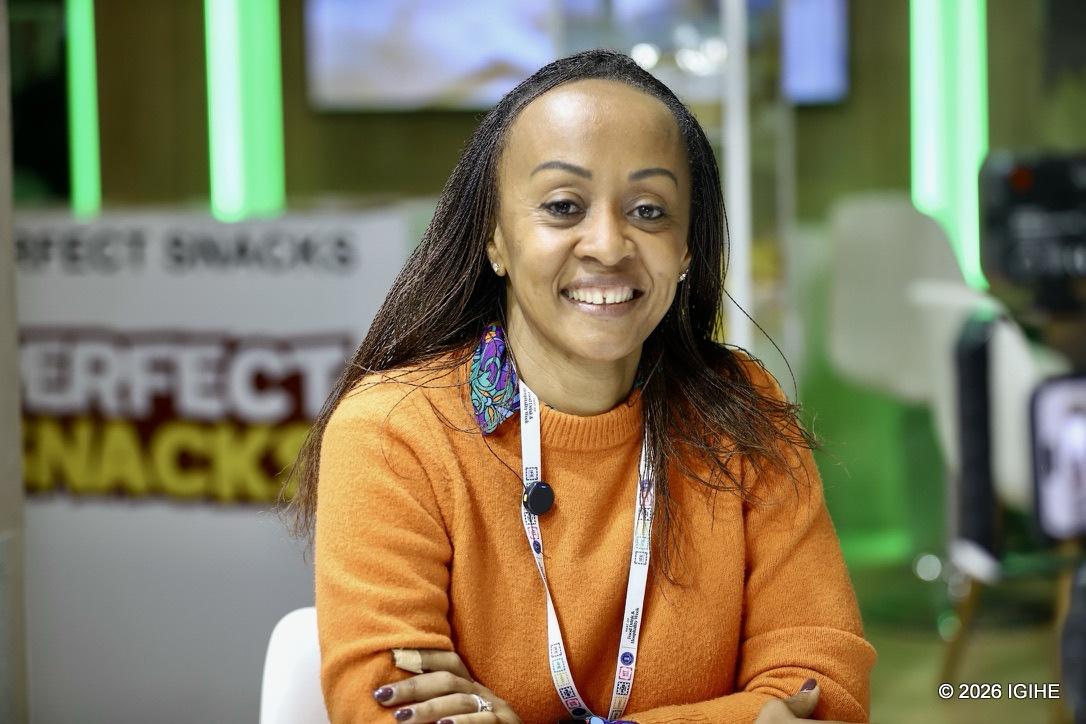
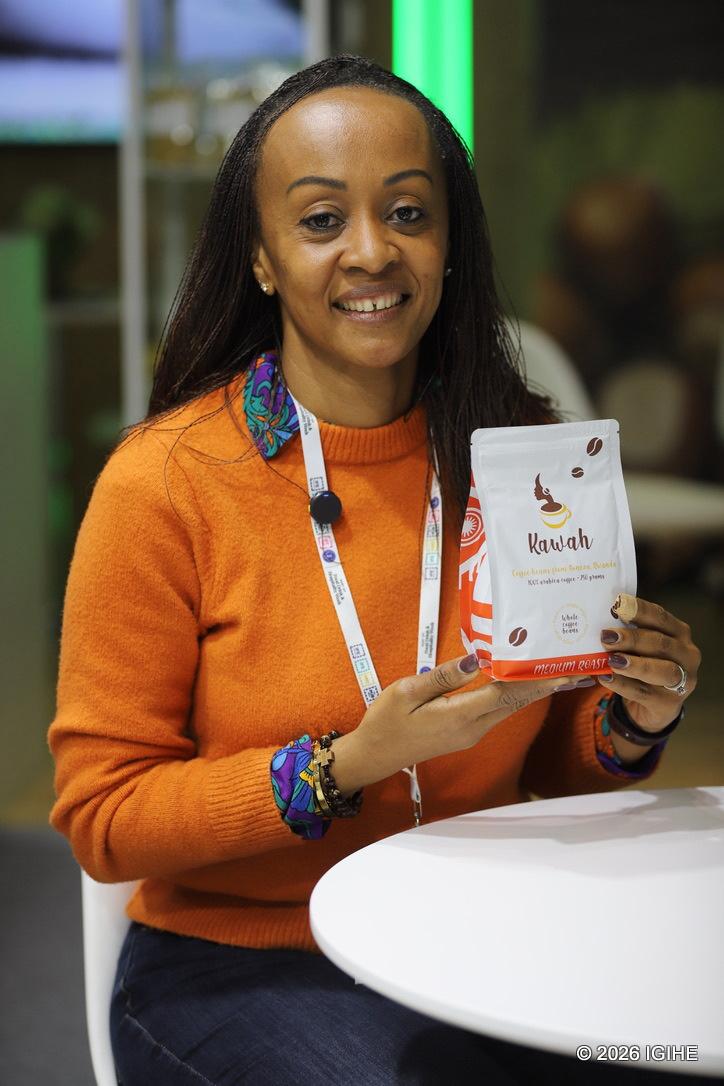
From her early studies in interior architecture to leading an internationally recognized coffee brand, Kubwimana combines creativity, heritage, and entrepreneurship in a journey that celebrates both her roots and Rwanda’s growing prominence in the global coffee market.
IGIHE spoke with her during the recent International Food and Drink Event (IFE) trade show in London about her career, the evolution of Kinunu, and the story behind the coffee that has captured international attention.
IGIHE:Your academic and professional background is in architecture, yet today you lead a coffee business. How did this transition come about?
Michaelle Kubwimana: I wasn’t initially destined for the coffee sector. I completed my bachelor’s degree in interior architecture in 2001 in South Africa, and later earned my master’s degree in 2006 in Italy. I practiced in this field for several years, running my own architecture business in Rwanda before gradually becoming involved in the family coffee enterprise.
Can you share how you became involved in the family coffee business?
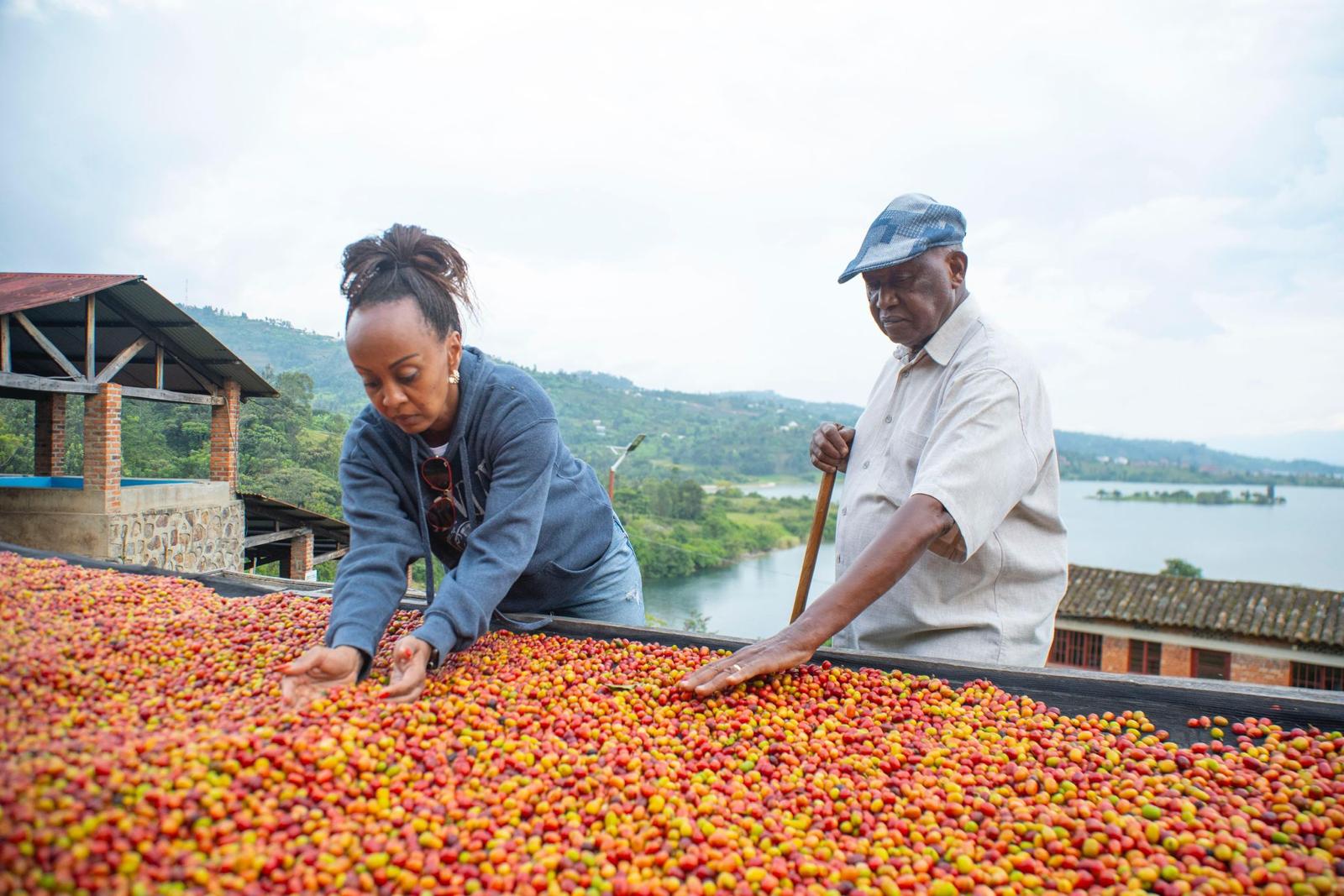
Kubwimana: By the time I finished my studies, my father had already started the coffee farm in his native village, working with one of my brothers. That village has always been central to our family life, and I spent much of my childhood there. Over time, I developed a genuine interest in the farm, particularly as I saw the positive impact it had on the local community.
Kinunu today seems to be much more than a coffee farm. How has it evolved?
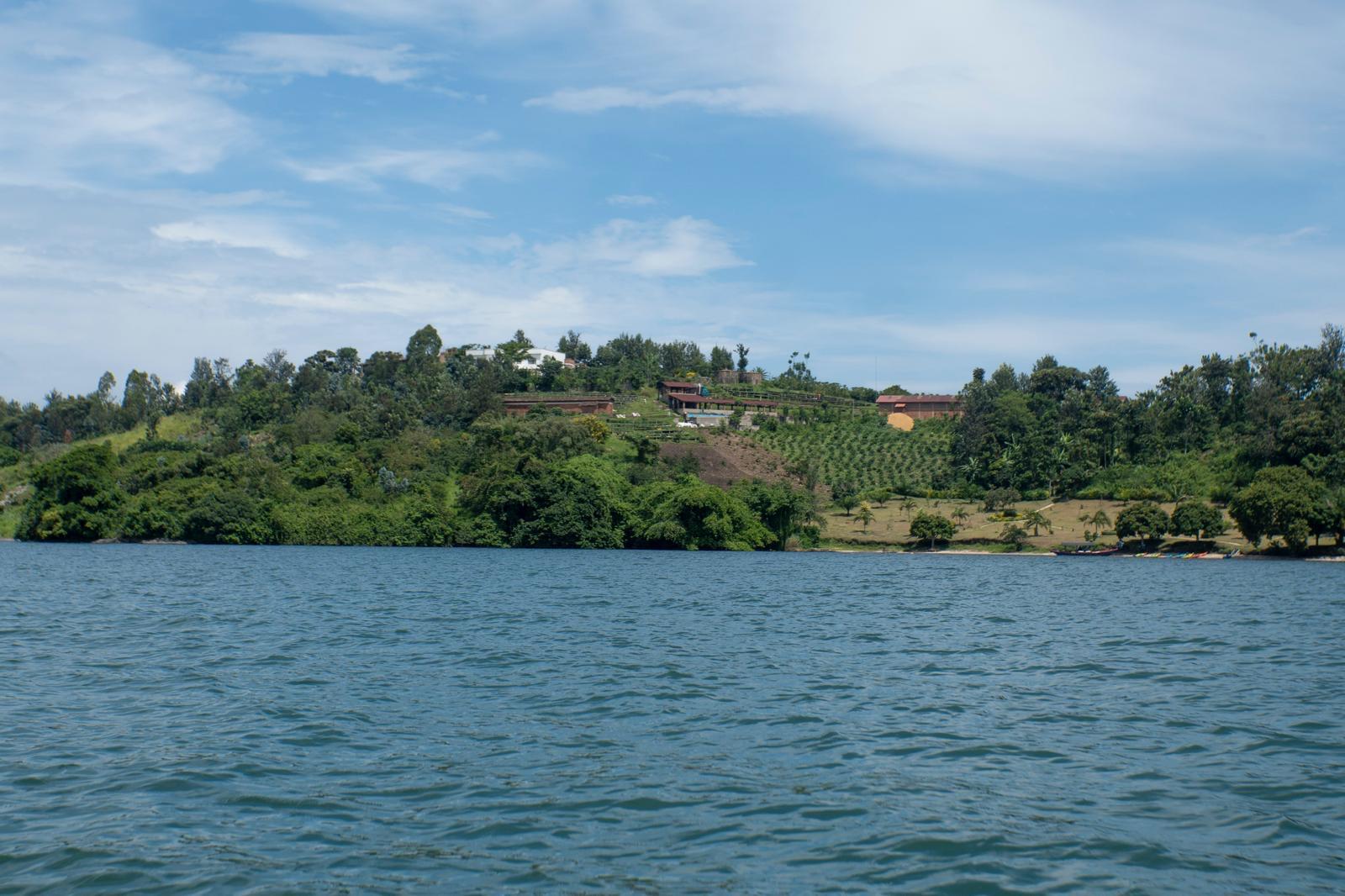
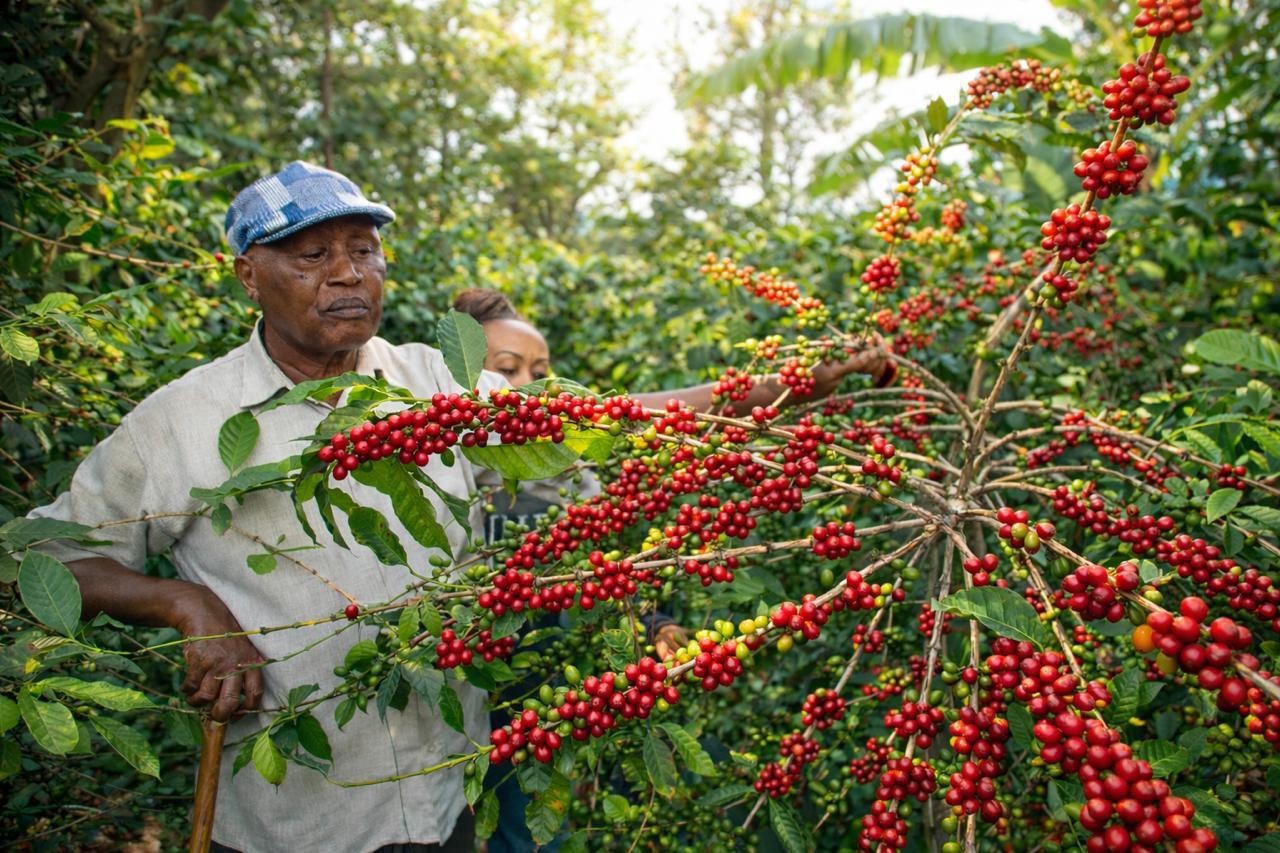
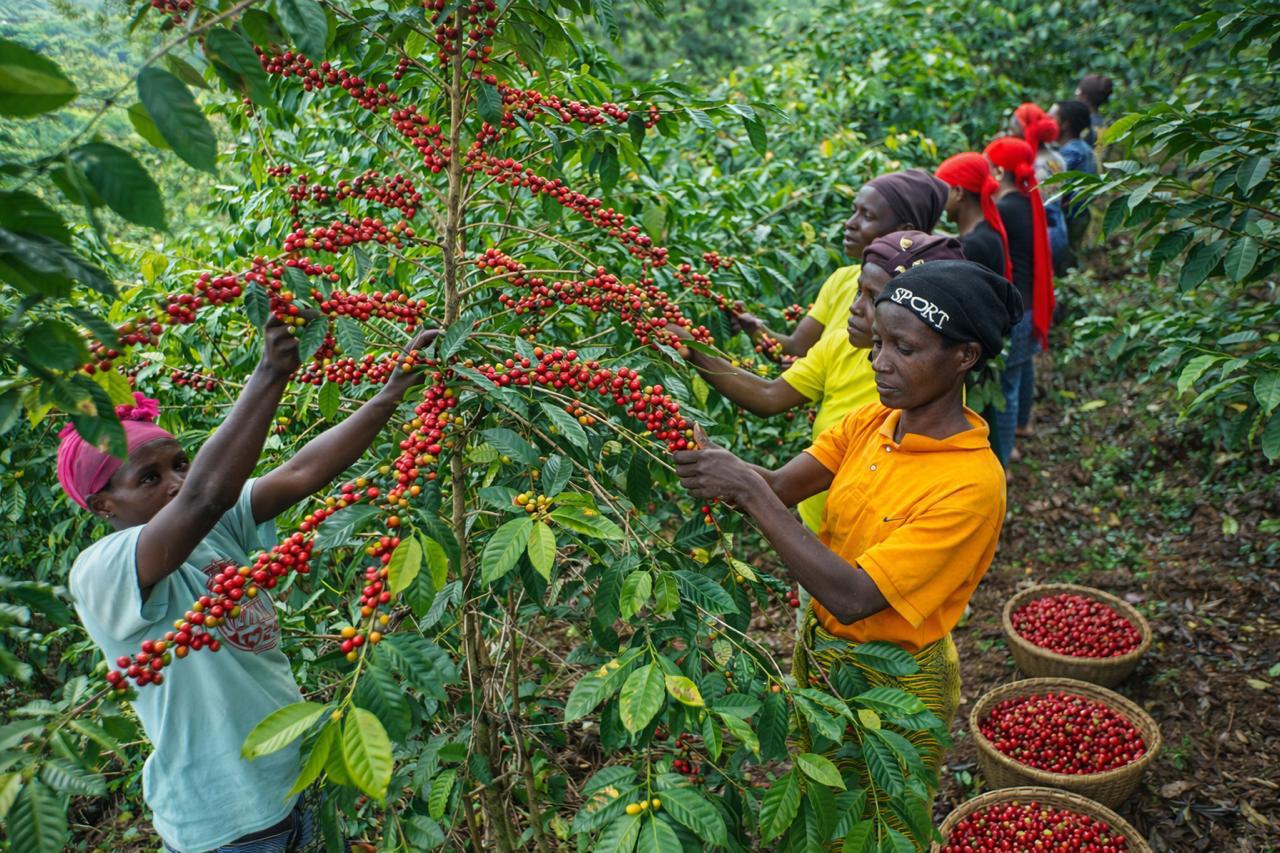
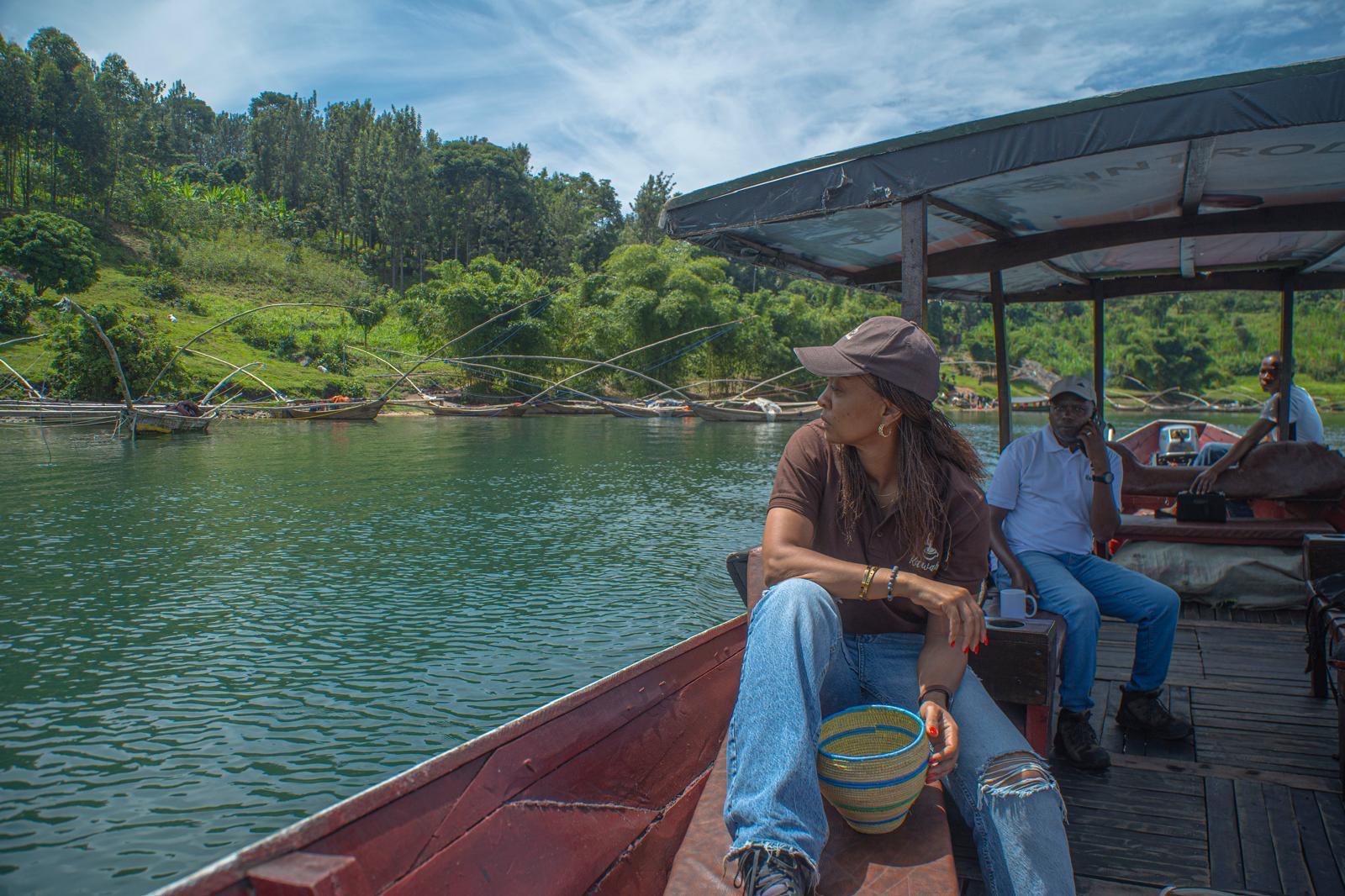
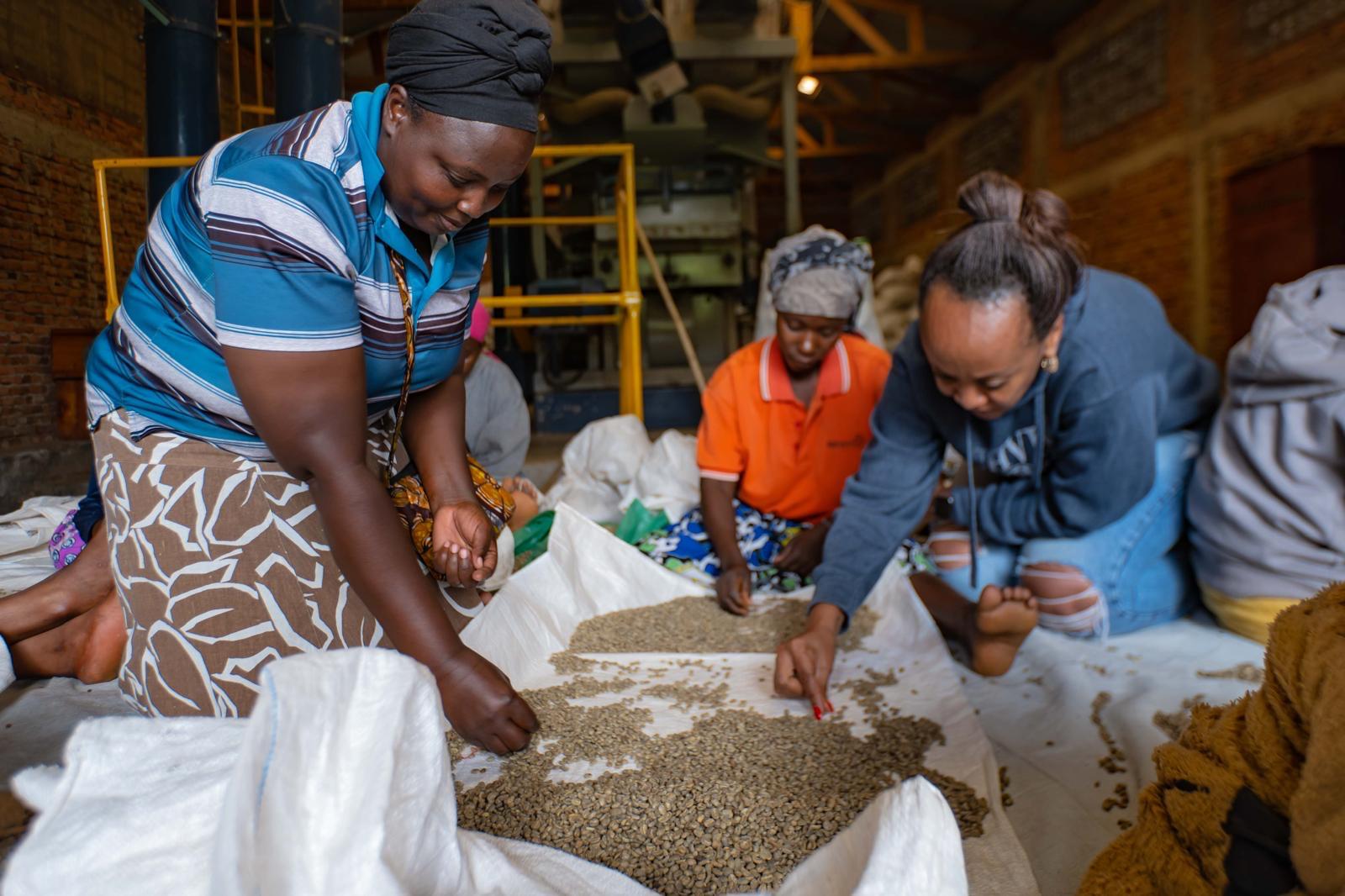
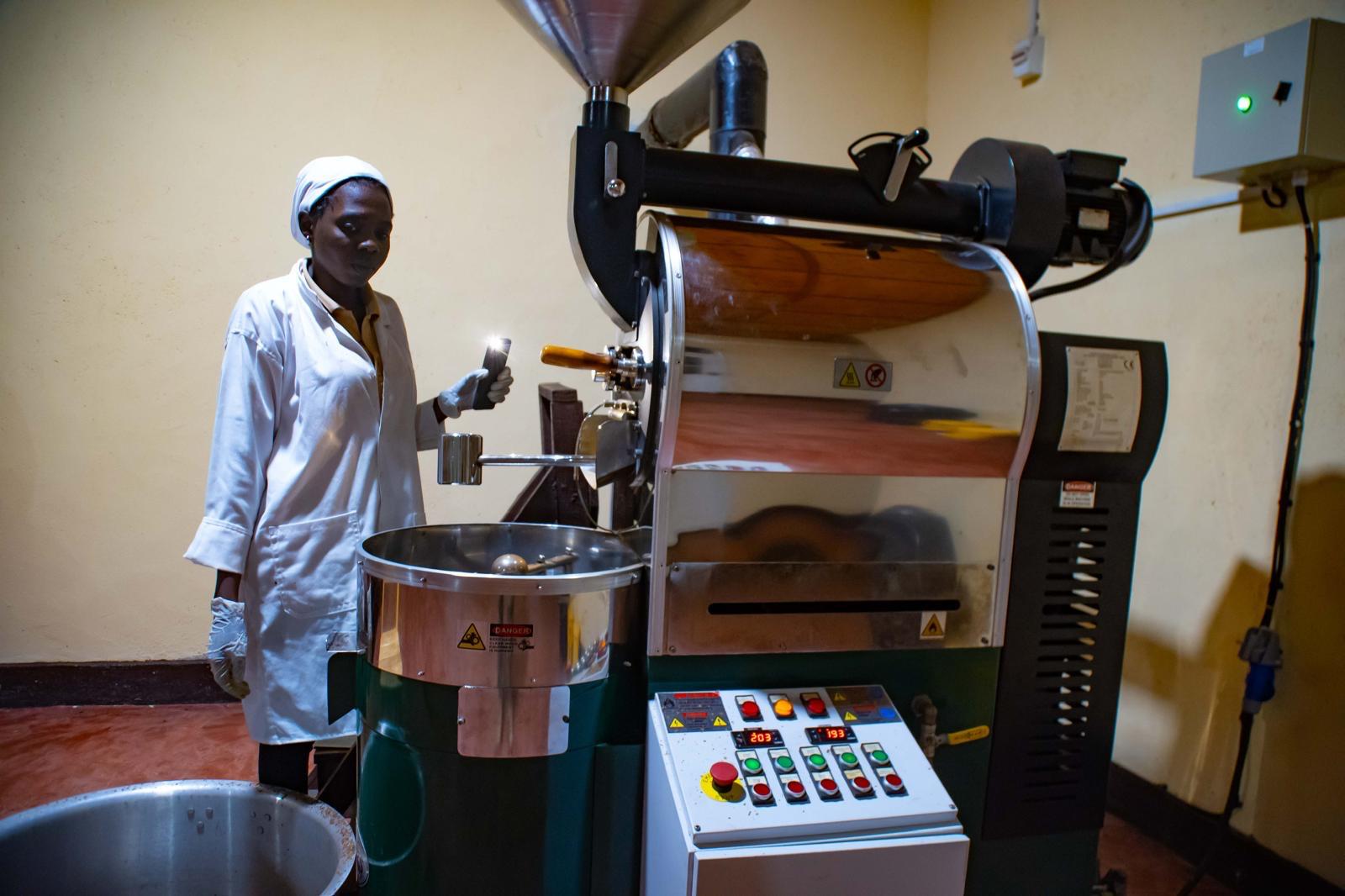
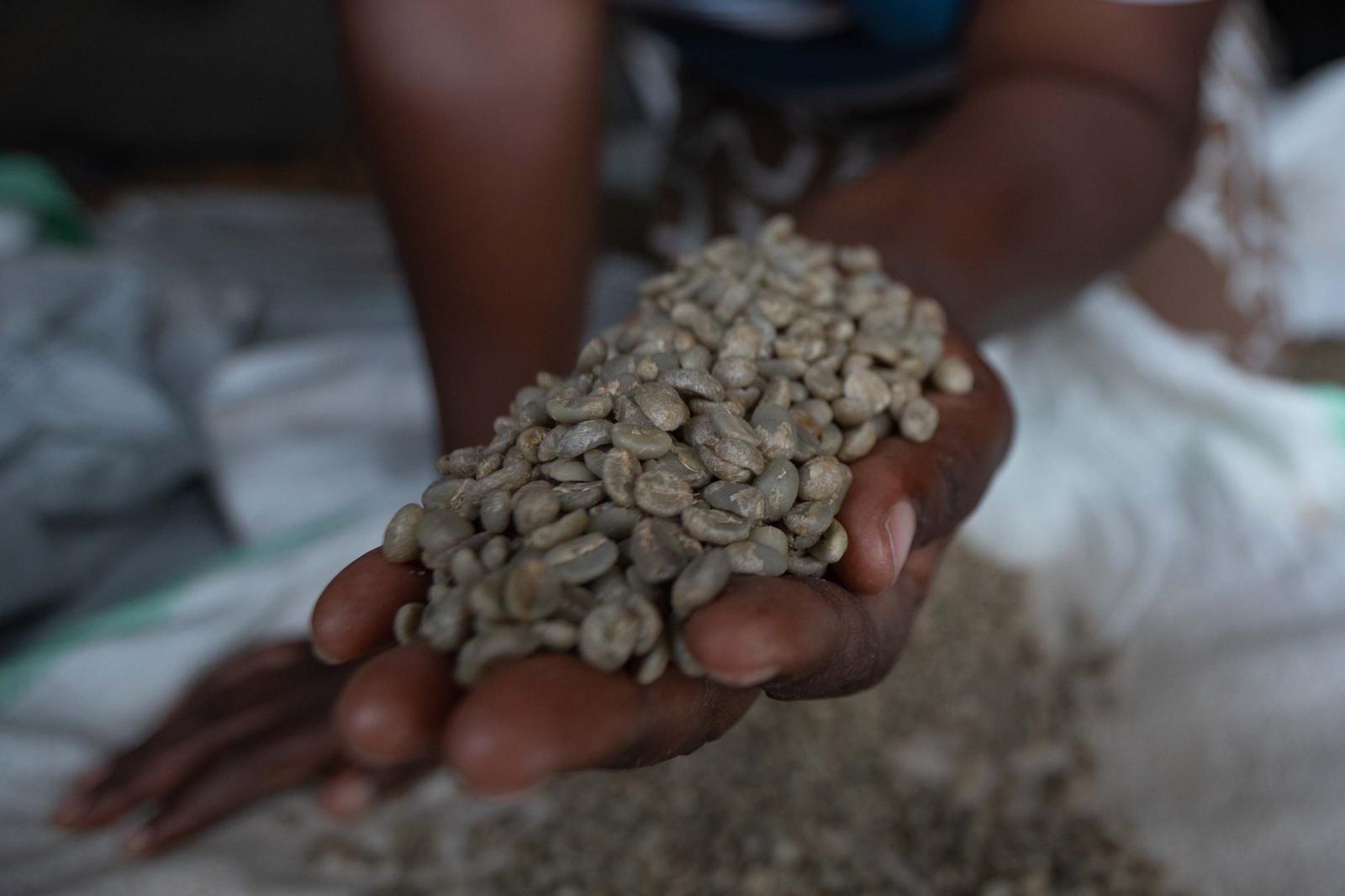
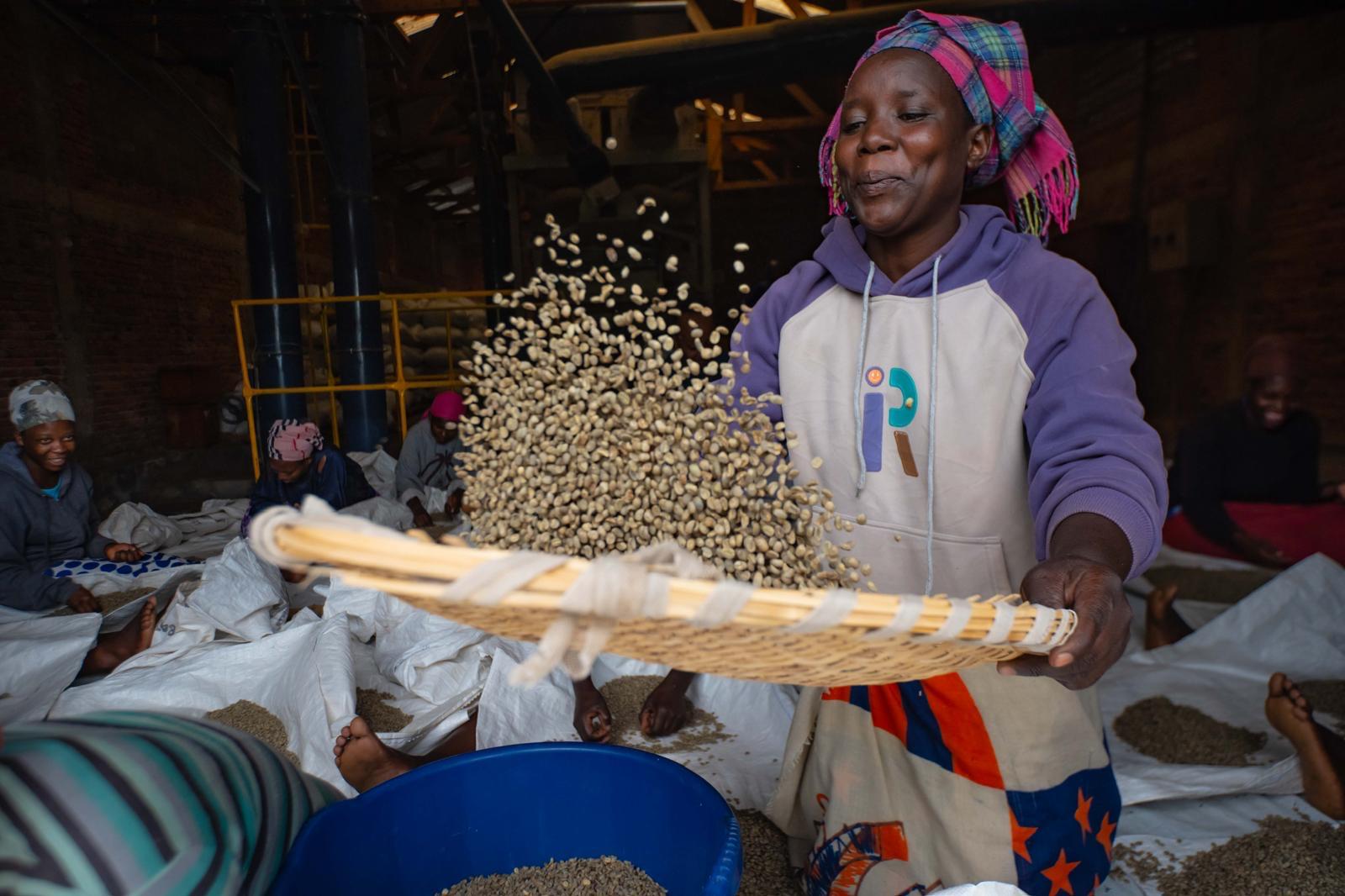
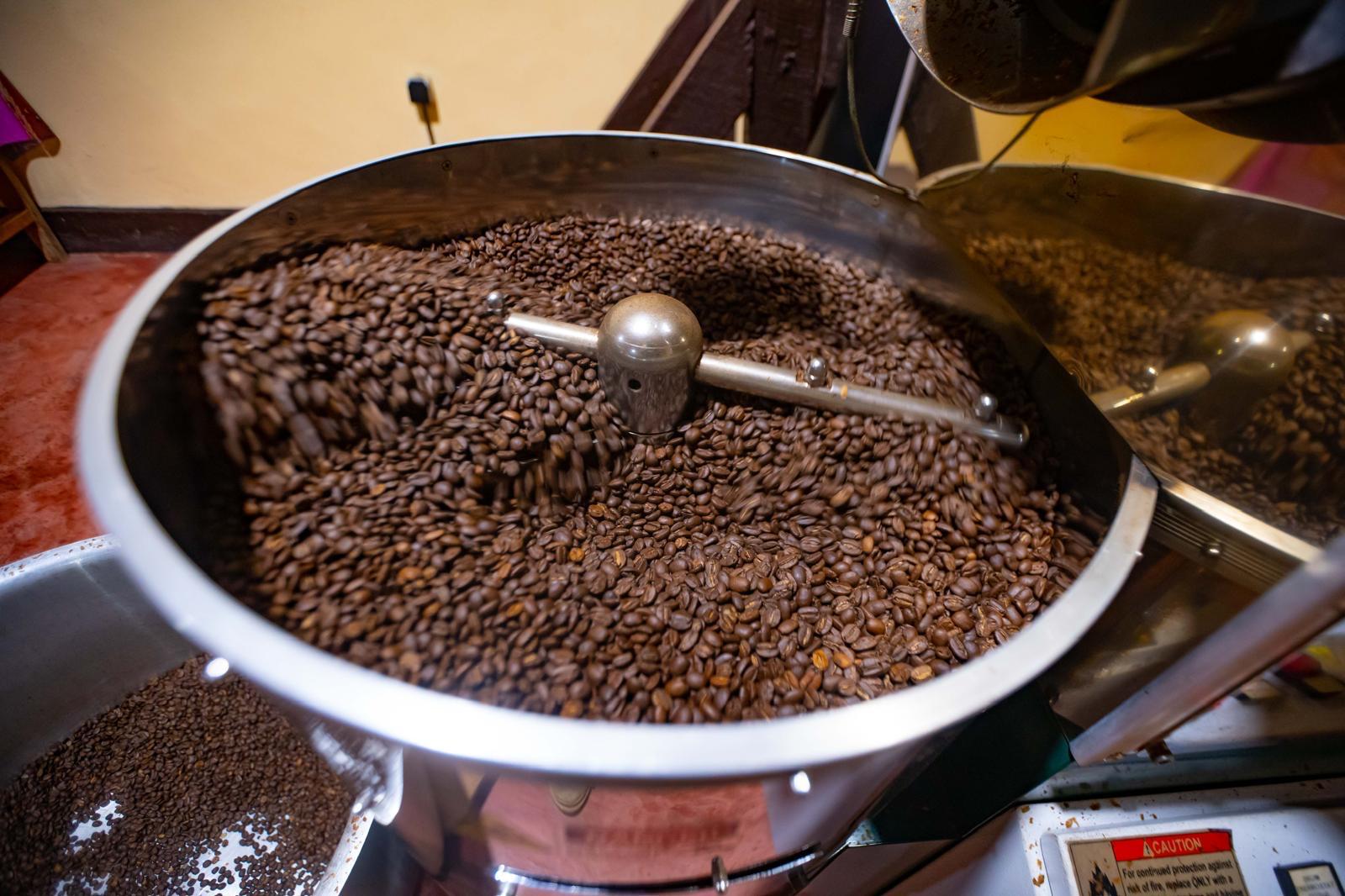
Kubwimana: Absolutely. What started as a small farm aimed at supporting the village and surrounding region has grown into a full ecosystem. We now operate a coffee washing station, host tours for both local and international visitors, and offer a guesthouse and restaurant managed by my sister. Kinunu is recognized by the Rwanda Development Board as a key stop along the Congo Nile Trail, blending heritage, tourism, and community development.
You have also played a role in expanding Rwandan coffee internationally. What has the journey been like?
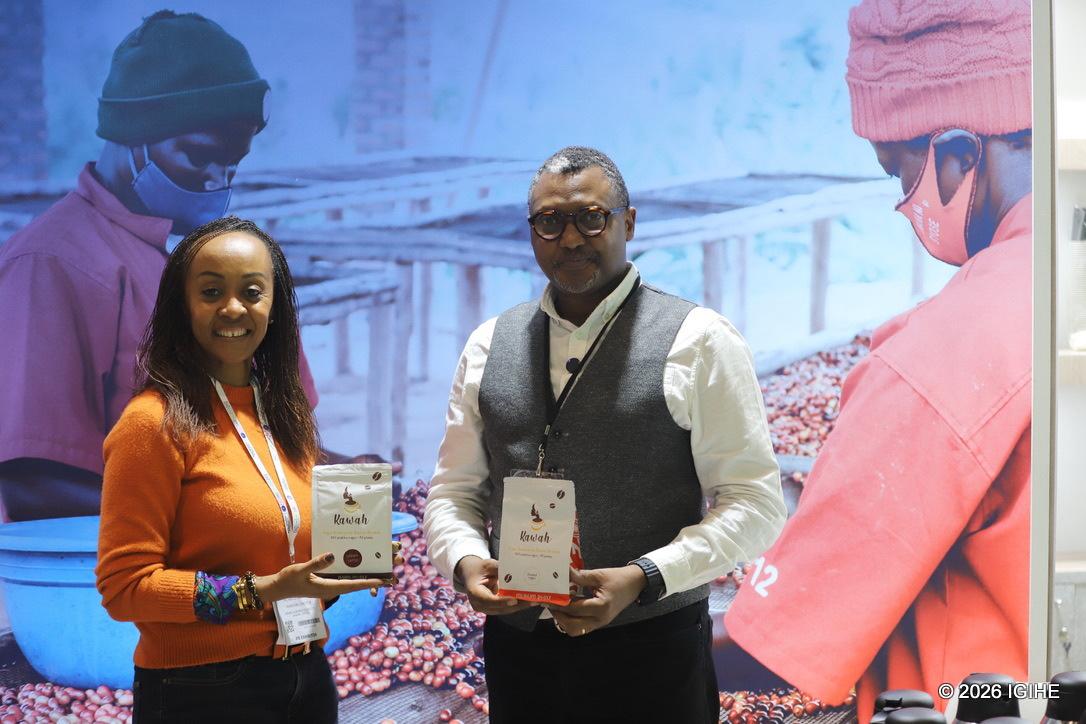
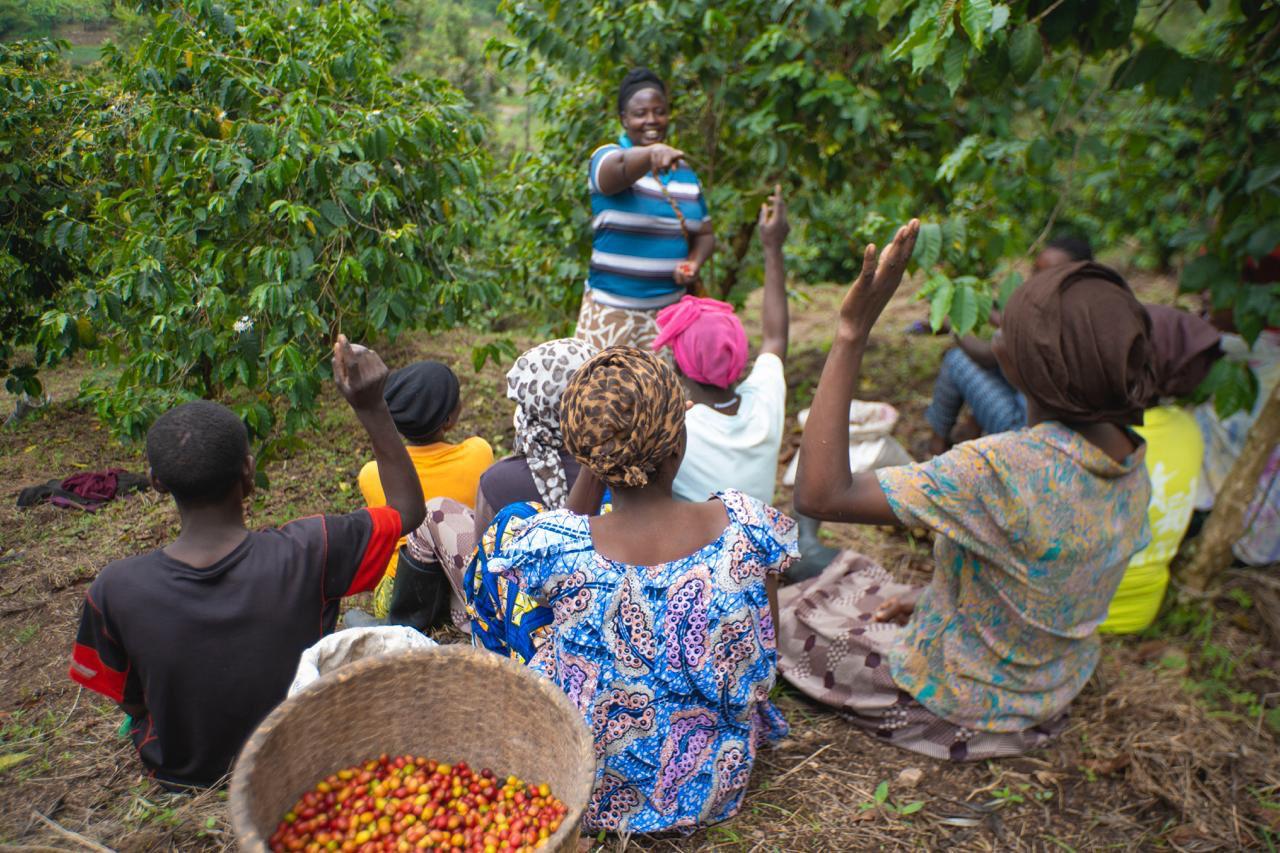
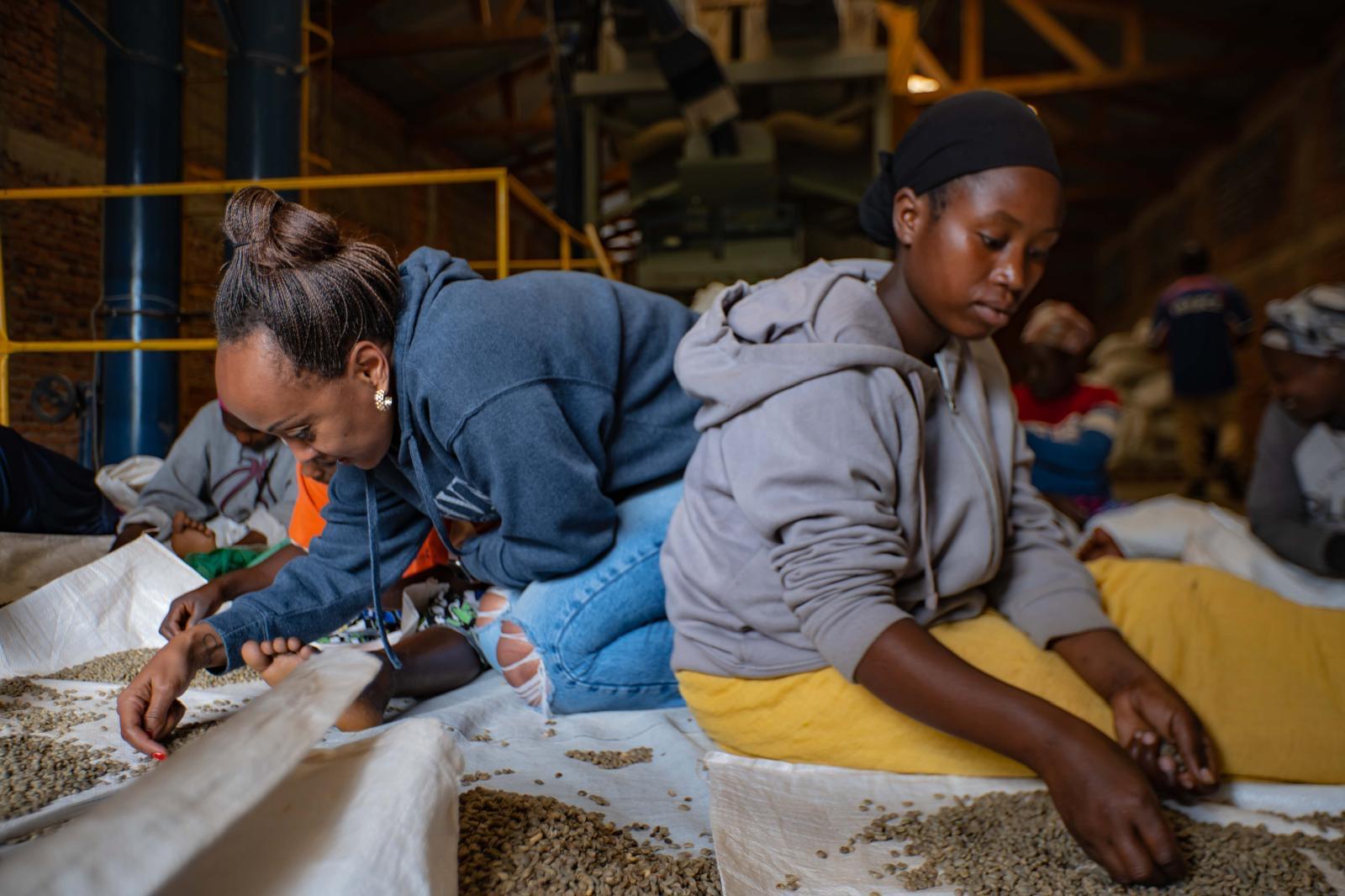
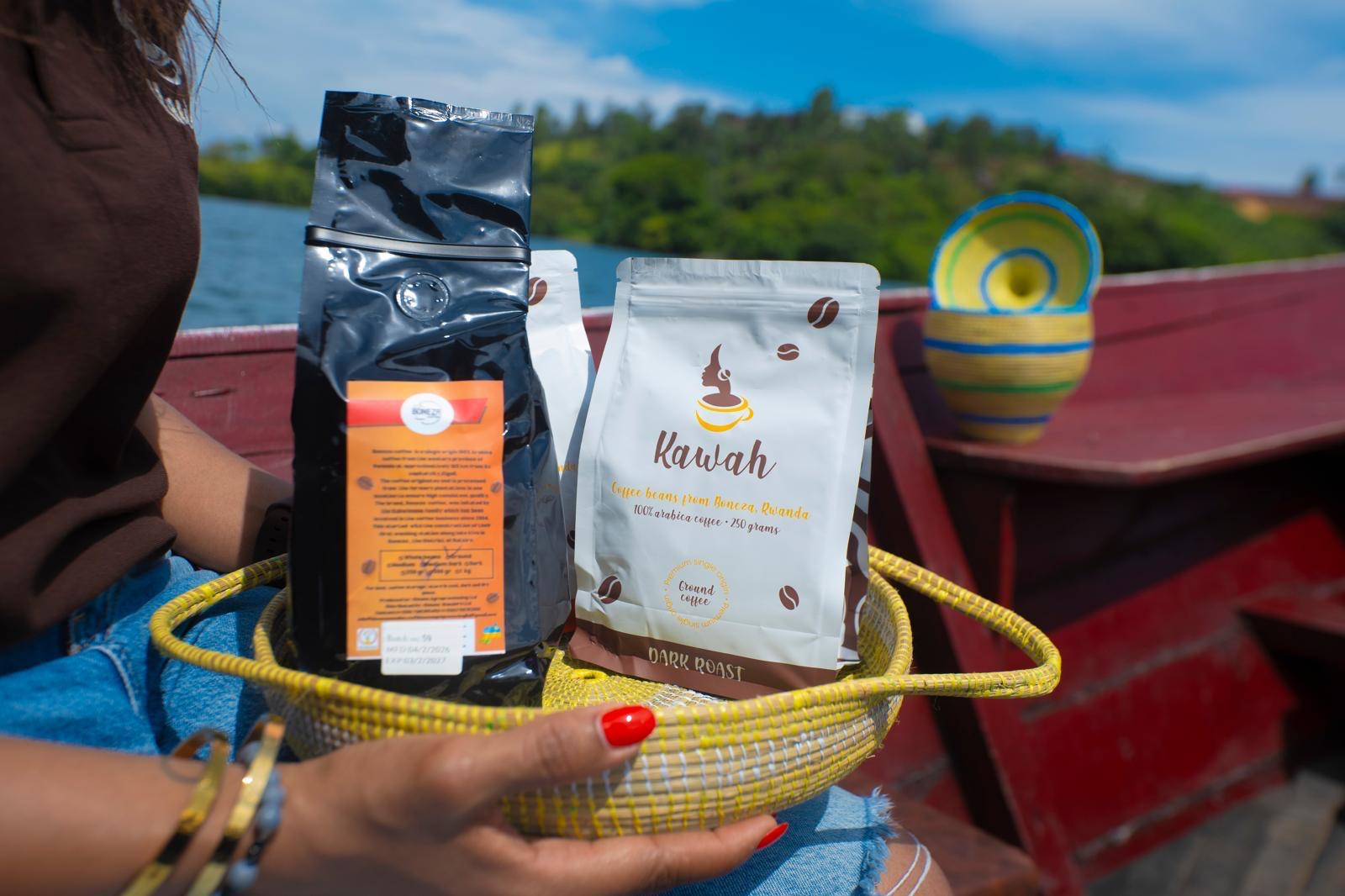
Kubwimana: In 2014, I began promoting our coffee abroad, especially in Dubai, through Boneza Coffee. In 2020, after moving to Singapore, I launched Kawah Coffee, targeting the international market. The goal was not just to showcase our coffee but also to highlight the stories of our farmers—90% of whom are women. By September 2022, the brand was registered in the UK after we relocated there.
What inspired you to formally take on the leadership of Kinunu Agroprocessing?
Kubwimana: It was a gradual decision fueled by both passion and responsibility. Kinunu is more than a business—it’s a family legacy. Leading it allows me to honor the heritage of my father and grandfather while supporting the community that has grown with the farm.
How do you see Rwandan coffee positioned in the global market today?
Kubwimana: Rwanda has made a clear strategic choice to focus on quality. Despite its small size, the country produces coffee under excellent conditions, which is why Rwandan coffee is now recognized among the best in the world. Initiatives such as the Visit Rwanda brand have also helped increase the country’s visibility internationally, making it much easier today to introduce Rwandan coffee to new markets compared to a few years ago.
Any final thoughts you’d like to share?
Kubwimana: Taking over Kinunu is about continuing a family and human story. It’s about preserving heritage, staying true to our values, and looking forward, ensuring that the legacy of our coffee farmers continues to thrive both locally and globally.
Michaelle Kubwimana, the Managing Director of Kinunu Agroprocessing, is redefining the legacy of her family’s coffee farm. Kubwimana during an interview with IGIHE at IFE-2026
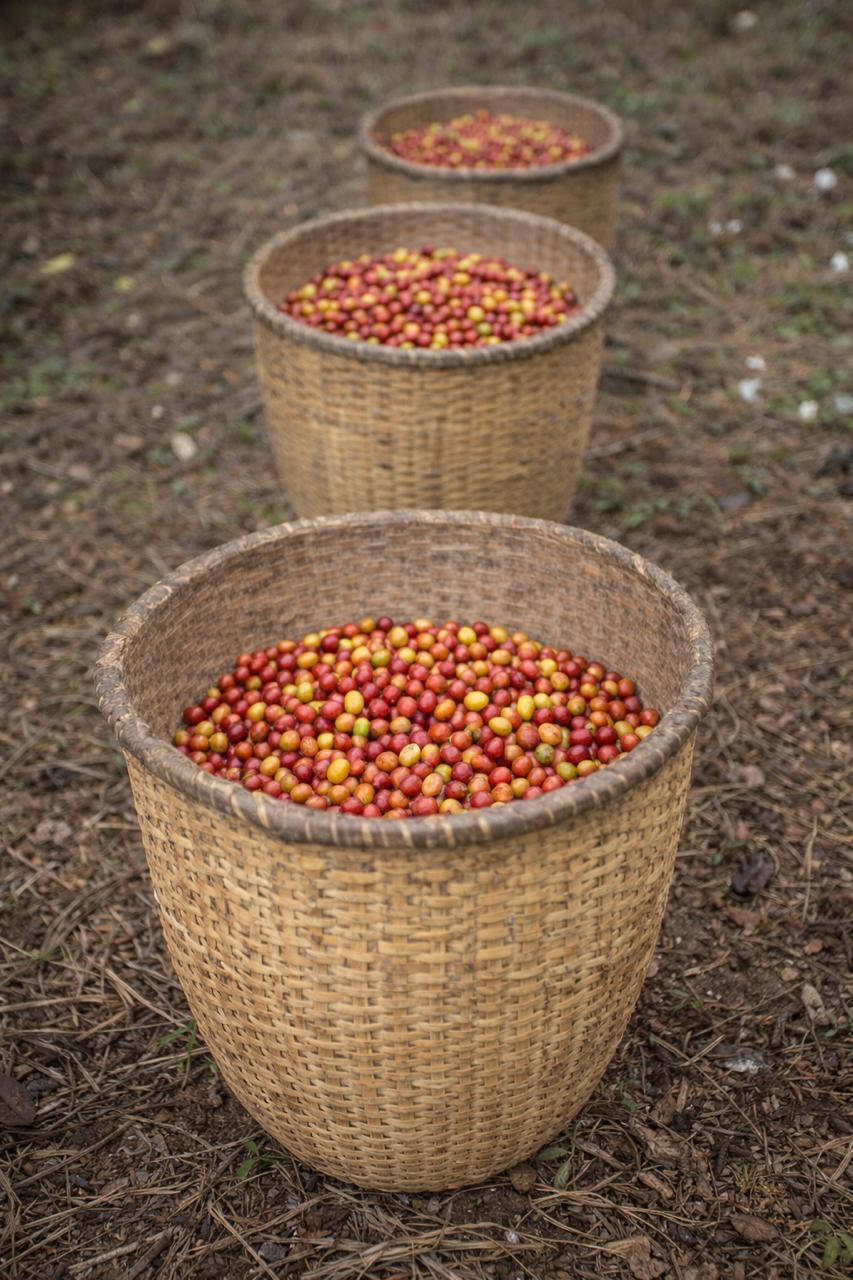
Photos showing Kubwimana and her father with farmers working on their farm in Kinunu