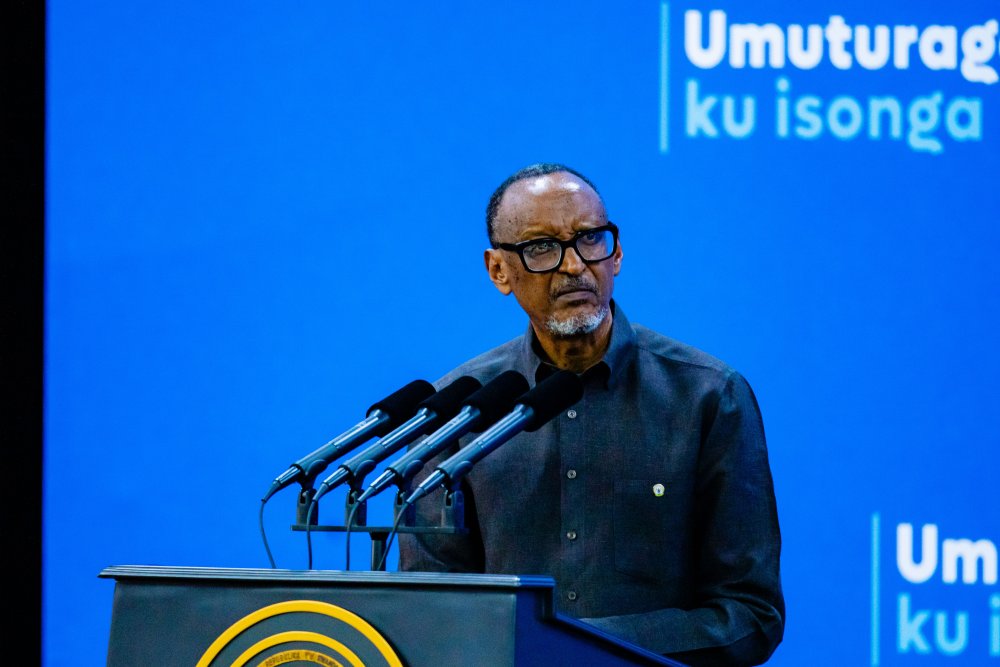
He made the remarks while closing a national meeting of central and local government leaders held at the Gako Military Academy, attended by district officials, cabinet ministers, and other senior government representatives.
The meeting examined ongoing governance challenges, including weak coordination among leaders, inefficiencies in service delivery, and other persistent shortcomings.
In his opening remarks, the Prime Minister cited findings from the National Institute of Statistics, noting a decline in service delivery performance, from 78.2% in 2023 to 75.8% in 2024, and further down to 71.7% in 2025.
Before delivering his address, Kagame was informed that leaders had acknowledged their shortcomings and committed to improving their performance. He questioned whether the issues raised were new to those present.
“Who here is hearing this for the first time? That would mean there are issues beyond what has been acknowledged. Otherwise, we should continuously assess what is not working, put everything in order, and implement corrective measures. But what we end up with is repetition. So what exactly is the problem?” he asked.
The President expressed concern over leaders who repeatedly make the same mistakes, apologise, and promise not to repeat them, only to fall into the same patterns again.
“Making the same mistake repeatedly, apologising for it, and repeating it again, I don’t understand that as a normal way people make mistakes. It becomes a problem. These are mistakes that are repeatedly made by the same individuals, including those in leadership positions,” he said.
He stressed that if a leader continues to repeat the same mistakes, it reflects a lack of understanding that must be addressed.
The Head of State further questioned whether the issue lies in how responsibilities are understood and executed across leadership structures.
“Is the problem within us as Rwandans? All of you seated here understand your responsibilities and what needs to be done, perhaps even better than I do. Yet we still face these challenges,” he said.
He also highlighted weaknesses in planning and implementation, noting that failure to align plans with execution leads to ineffective outcomes.
“Planning must go hand in hand with implementation. Even when plans are well designed, if they are not aligned with execution, it becomes a problem. You cannot expect meaningful results without proper planning,” he noted.
Citing an example from the Eastern Province, Kagame questioned why an irrigation project intended to also supply water to residents had not achieved both objectives.
“You follow up on one component and neglect the other. How can you achieve the intended outcome?” he asked.
The Governor of the Eastern Province, Pudence Rubingisa, explained that while part of the irrigation component had been implemented, the water supply aspect had been overlooked.
Kagame questioned the lack of coordination among stakeholders involved in the project, emphasising the importance of communication in delivering results.
“After this, you go and communicate, something I have not seen in the past 31 years,” he remarked.
Rubingisa acknowledged the communication gap and noted that leaders had committed to improving coordination and ensuring citizen participation in providing feedback on projects affecting them.
President Kagame concluded by stressing the need for urgent behavioural and operational changes among leaders, urging them to move beyond repeated mistakes and apologies, and to fully understand and fulfil their responsibilities.
Leave a Reply