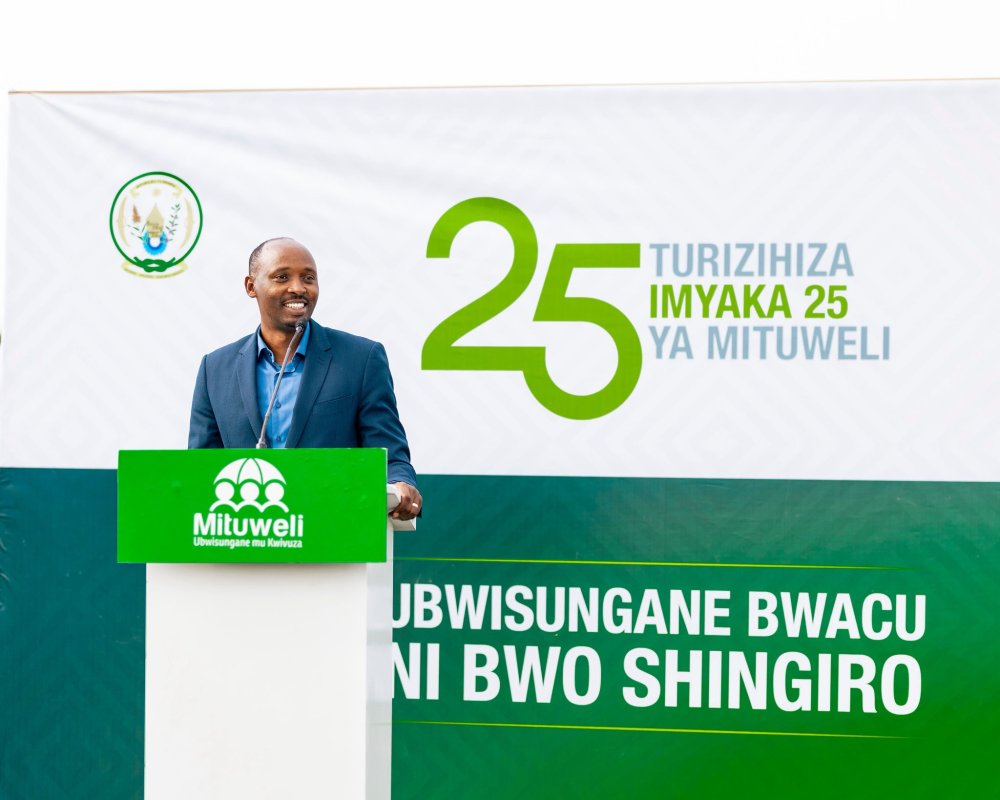
He made the remarks on March 19, 2026, during a session with the Parliamentary Committee on Governance, Gender Equality, and Women’s Empowerment.
According to Dr. Nsanzimana, the addition of services that were previously not covered has significantly raised the cost borne by the Rwanda Social Security Board (RSSB). These new services are expected to increase annual expenditure by at least Rwf 21 billion.
On February 24, 2026, the government announced reforms aimed at strengthening Mutuelle de Santé, a program that has been in place for 25 years and is rooted in the principle of solidarity to improve access to healthcare for all Rwandans.
Initially, citizens contributed Rwf 1,000, a figure that was later raised to Rwf 3,000 in 2011. Under the new structure, contributions are now categorized based on socio-economic status: citizens in the first social registry will be fully subsidized by the government; those in the second category will pay Rwf 3,000; the third category Rwf 5,000; the fourth Rwf 8,000; while those in the fourth social registry will contribute Rwf 20,000. RSSB estimates that about 90% of members will pay between Rwf 4,000 and Rwf 8,000.
The minister emphasized that the increase reflects the inclusion of costly but essential treatments such as cancer care, kidney dialysis, organ transplants, orthopedic and spinal surgeries, and assistive devices for people with disabilities, including hearing and vision impairments.
Last year, the scheme spent Rwf 98 billion, while member contributions totaled Rwf 31 billion, just 34% of total funding, highlighting the financial gap the reforms seek to address.
Dr. Nsanzimana detailed the distribution of contributors: 6.89% of citizens are fully covered by the government due to extreme poverty; 23% will pay Rwf 3,000 with a government top-up of Rwf 1,000; over 35% will pay Rwf 5,000; 26% will contribute Rwf 8,000; and 8% will pay Rwf 20,000.
He noted that efforts are underway, led by the Ministry of Local Government (MINALOC) and RSSB, to correct misclassifications in socio-economic categories to ensure fairness. These adjustments are expected to be completed by July 2026, when the new insurance year begins.
Despite the increase, the minister stressed that contributions remain relatively low compared to the cost of services provided. For instance, the inclusion of cancer treatment drugs alone has added at least Rwf 9 billion annually to RSSB expenditures.
“These costs are substantial, which is why we had to review how to strengthen the scheme financially, while ensuring that the burden on citizens remains manageable,” he said, noting that earlier proposals had considered raising contributions up to Rwf 15,000 from Rwf 3,000.
He warned that failing to adjust contributions over time had strained service delivery. “It was like trying to draw water from an empty container. We must reinvest in the system, especially now that we have added very expensive services,” he said.
The expansion of coverage is already improving access to care. Previously, dialysis sessions covered by the scheme were limited to 18 per patient, after which individuals had to cover the costs themselves.
Each dialysis session costs about Rwf 75,000, and patients typically require at least three sessions per week, making it unaffordable for many without insurance support.
Dr. Nsanzimana also highlighted progress in specialized treatments, including kidney transplants now performed by Rwandan doctors trained abroad, as well as plans to expand services such as heart surgery.
He noted that in 2024, more than 6,000 patients in need of orthopedic surgery had been unable to access care, but have since been treated following the inclusion of such services under Mutuelle de Santé.
Lawmakers called for increased public awareness to ensure citizens understand the reasons behind the changes. MP Deogratias Nzamwita pointed out that similar resistance was observed when RAMA and Mutuelle de Santé were first introduced, but public understanding later improved.
MP Etienne Mvano Nsabimana added that clear communication would help ease public concerns.
Meanwhile, Anastase Nabahire, Chairperson of the committee, urged authorities to address persistent issues such as inconsistencies in prescribed medication, where treatments recommended by specialists are sometimes altered by RSSB-affiliated doctors, raising questions among patients.
The revised contributions have already begun to be collected and will officially take effect in July 2026.
Leave a Reply