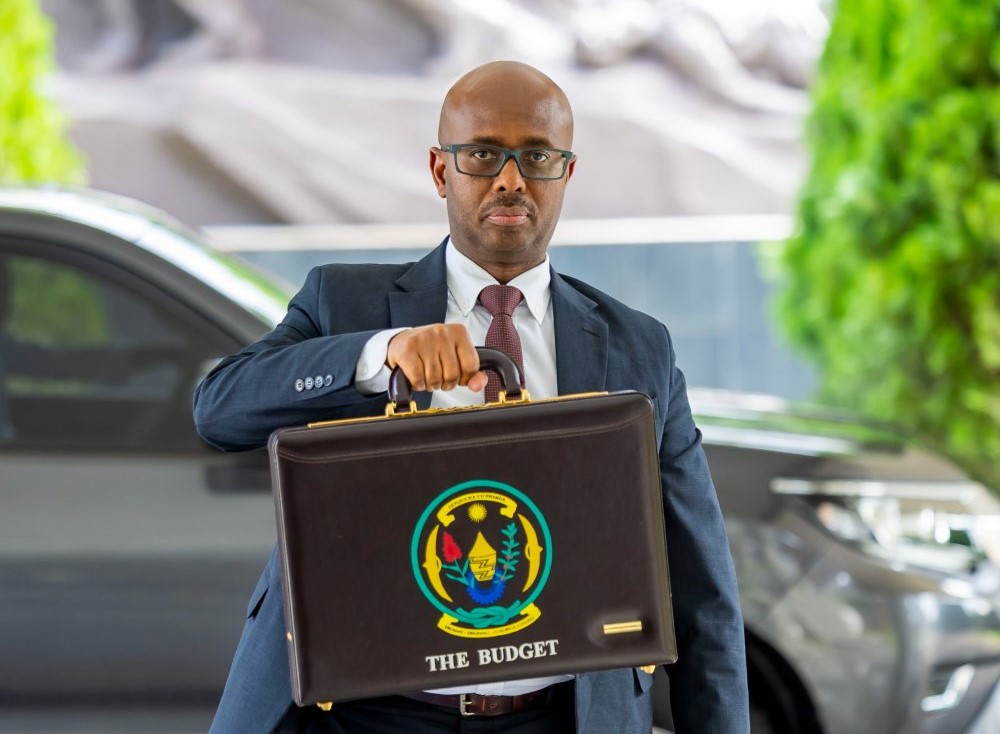
On February 12, 2026, the Minister of Finance and Economic Planning, Yusuf Murangwa, announced that the national budget for 2025/2026 had been revised downward from Rwf 7,032.5 billion to Rwf 6,952.1 billion.
The reduction stems largely from adjustments in financing arrangements for Phase II of the new Kigali International Airport project, which lowered the amount required in the 2025/2026 fiscal year by Rwf 168.2 billion. Changes were also made to the repayment plan for loans owed by RwandAir, with repayments now scheduled to begin gradually from the 2026/2027 fiscal year.
On February 18, 2026, the Senate plenary concluded that the revised budget is well structured and aligned with the pillars of Rwanda’s second National Strategy for Transformation (NST2, 2024–2029).
Funding for social transformation has increased from Rwf 1,526.9 billion to Rwf 1,641.8 billion, representing 23.6% of the total budget. Allocations for good governance have also risen, from Rwf 1,088.3 billion to Rwf 1,105.1 billion, accounting for 15.9% of total expenditure.
Meanwhile, funding for economic transformation has been reduced from Rwf 4,417.2 billion to Rwf 4,205.1 billion, representing 60.5% of the budget. Overall development expenditure, however, has increased from Rwf 2,719.7 billion to Rwf 2,837.2 billion, an increment of Rwf 117.5 billion. Funding for projects alone has risen by Rwf 253.3 billion, reaching Rwf 2,115.8 billion.
Government projections also indicate higher domestic revenue collections than previously expected. Tax and non-tax revenues are projected to rise from Rwf 4,105.2 billion to Rwf 4,146.2 billion, an increase of at least Rwf 41 billion.
Chairperson of the Senate Committee on Economic Development and Finance, Fulgence Nsengiyumva, said the projected growth in tax revenue reflects increasing taxpayer awareness and strengthens Rwanda’s path toward self-reliance.
Data from the Rwanda Revenue Authority show that between July and November 2025, tax collections reached Rwf 1,456.3 billion, surpassing the target of Rwf 1,449.5 billion. Revenue collected on behalf of districts also exceeded expectations.
Domestic borrowing is set to increase significantly, nearly tripling from Rwf 136.6 billion to Rwf 468.4 billion. Minister Murangwa noted that domestic borrowing provides more affordable financing while supporting the growth of local financial institutions.
He added that borrowing in foreign currencies can expose the country to exchange rate losses, whereas local banks remain sufficiently capitalized to support both public and private investment.
External borrowing, on the other hand, will decline by Rwf 512.1 billion, dropping from Rwf 2,151.9 billion to Rwf 1,639.8 billion. Grants are expected to increase from Rwf 585.2 billion to Rwf 649.6 billion.
Combined tax revenues and borrowing will account for 90% of the total budget, slightly down from 91% in the initially approved budget, an indication of continued progress toward financial self-reliance.
The Senate’s recommendations will now be submitted to the Chamber of Deputies, where the Committee on National Budget and State Patrimony will conduct a clause-by-clause review before final approval.
The Government of Rwanda also reported that by December 2025, 65% of the budget approved by Parliament in June 2025 had already been implemented.
Leave a Reply